

The CDP portal opened on April 27th. If you received a customer request to disclose and you're not sure what to do with it, here's what you need to know.
In 2025, of the 23,100+ companies who reported through CDP's Supply Chain program, more than a third were manufacturers. And more than half of those companies requested didn't respond. In fact, overall, more than 45,000 companies were requested to disclose.
Every one of them gave their competitors an opening.
What Is CDP Reporting?
CDP is a voluntary framework for environmental reporting. It started in 2000 with climate reporting and has since expanded to cover deforestation, water use, plastics, and biodiversity. It's one of the most widely used environmental reporting frameworks in the world, both for companies disclosing their own performance and for the buyers using it to evaluate their suppliers.
Every year, CDP opens a portal in spring and closes it in autumn. In 2026, that window officially runs from April 27th to October 26th – although if you want a score, the date is September 14th. Disclosures are scored A to D across each reporting topic, and those scores are public.
Why CDP Reporting Targets Manufacturers More Than Any Other Sector
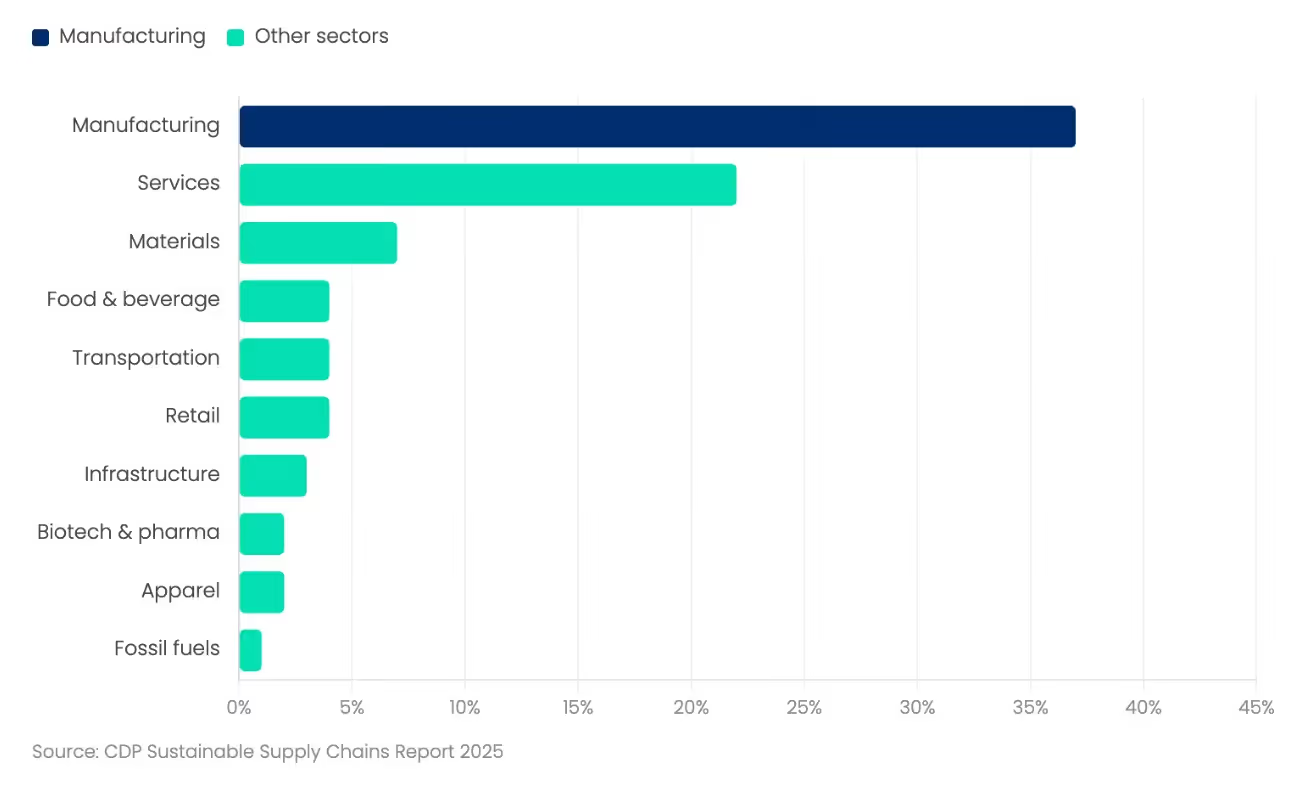
Because manufacturing sits at the center of the supply chain, sustainable manufacturing is critical to every company's long-term climate and sustainability goals.
Over the last three years, manufacturers have consistently made up 38% to 40% of all CDP disclosures. That share isn't an accident.
Supply chain emissions (Scope 3) account for more than 26 times the average company's direct emissions (Scope 1 and 2). That means the biggest climate impact a company can have is engaging the manufacturers in its supply chain. Regulators and enterprise buyers know this, and they're acting on it.
What Happens If You Ignore a CDP Request
Ignoring a CDP request has two immediate consequences.
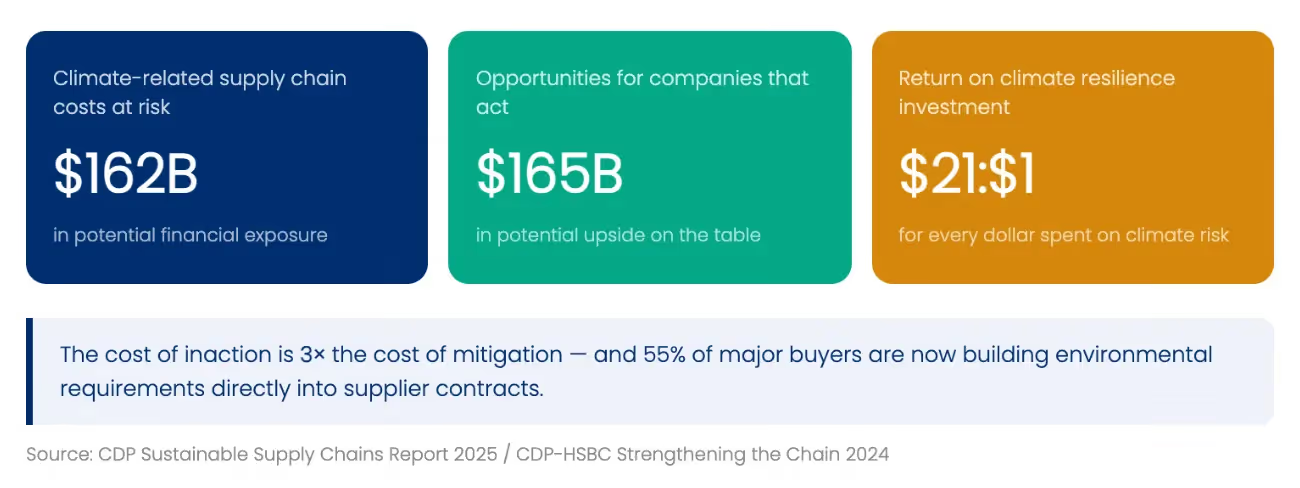
The first is commercial. In 2025, 55% of CDP Supply Chain members offered preferential contracts and deeper collaboration to suppliers that disclosed, up from 50% the year before.
Companies like Costco and Telstra have gone further, making annual CDP disclosure a contractual requirement for some tier-1 suppliers. Bosch runs a proprietary scoring system across its 3,200 suppliers and rewards top performers with better payment terms.
The second consequence is reputational. When you don't disclose, CDP lists you publicly as "Did Not Disclose." Any buyer evaluating you as a supplier can see that.
Most manufacturers receiving requests get them from more than one customer. That's two supplier relationships, two sets of incentives, and two pieces of competitive ground at risk every year they don't report.
Five Things Manufacturers Should Know Before Disclosing to CDP
Most manufacturers receiving a CDP request for the first time go straight to the questionnaire. But before you do, there are a few things worth understanding about how the process actually works.
- CDP doesn't just score what you do. It scores how well you can demonstrate it. First-time reporters who figure that out mid-submission don't get a second chance until next year. Documentation matters as much as action.
- You may qualify for the SME questionnaire. If you have fewer than 1,000 employees or received your request through a supply chain program, you're likely eligible. It's sector-agnostic and significantly shorter than the full questionnaire. Most manufacturers receiving customer requests qualify, but few realize it.
- The data you need probably already exists. The bulk of the questionnaire covers Scope 1, 2, and 3 emissions and a climate risk assessment aligned to the TCFD framework. That data usually lives somewhere in your operations, finance, or facilities. Finding and consolidating it is the hard part, not generating it from scratch.
- Your score is public. Unlike EcoVadis, where a weak score stays between you and the customer who asked for it, CDP scores are visible to anyone. That cuts both ways: a strong score becomes a competitive asset, but a rushed first submission gets seen by every buyer evaluating you. Improving year-over-year matters, and the levers that improve scores – science-based targets, acting on CDP's feedback, and demonstrating actual emissions reductions – take time to put in place.
- Decide upfront what you're disclosing on. Customer requests increasingly cover water, forests, and plastics alongside climate. In 2025, 60% of suppliers received multi-topic requests, up from 41% in 2023. Knowing which topics your customer is asking about before you set up your questionnaire will save you from having to redo your setup mid-submission.
Inside the CDP Questionnaire and Portal: What to Expect
Once you've worked through the preparation steps above and you're finally ready to log in, the portal itself has a structure that's worth understanding alongside the actual questionnaire.
- The portal has three phases. A Prepare phase to review requests and set up your team, a Respond phase to complete and submit the questionnaire, and a Get Insights phase where your score breakdown becomes available.
- Your questionnaire is customized to your organization. The setup questions at the start of the Respond phase determine which questions you'll actually be asked, based on your company size, sector, and the environmental issues you're reporting on.
- Each section of the questionnaire covers a different area of environmental performance (climate change, water security, forests, plastics, biodiversity, and ocean, which was added for the first time in 2026). You can complete them in any order, save your progress, and return as your data comes together. Autosave is on by default, but if you lose internet connection, offline mode only saves your work within the section you're currently in.
- Previous responses carry forward automatically if you've disclosed before. Review them before submitting. Outdated answers can affect your score.
- There is an admin fee required before you can submit. It needs to be processed in advance of your submission deadline.
What Strong CDP Manufacturing Scores Get You
The most immediate payoff is the clearest: keeping the customer who asked you to report and getting on the radar of the next one who asked a supplier that did not. But CDP disclosure compounds in three other ways that aren't as obvious from a single supplier request.
- The economic benefits: CDP’s Disclosure Dividend report found that companies that assess and act on their climate risks see returns of up to $21 for every $1 spent. The disclosure process forces a kind of operational audit, surfacing energy waste, supply chain inefficiencies, and risk exposure that pays back in cost savings and avoided losses.
- Future compliance: Climate disclosure rules are coming online globally, with sustainability reporting rules under California's SB 219 and the EU's CSRD. Plus, 36 jurisdictions are adopting rules aligned with the International Sustainability Standards Board (ISSB) standards, from the UK to Japan. CDP is built on the same TCFD and ISSB foundations as these regulations. Manufacturers that have already disclosed to CDP have done most of the underlying work for complying with these rules.
- Brand reputation: A CDP A or B score for climate isn't just a number on a scorecard. It's a credential that investors check, customers' reference, and prospective employees see. For mid-size manufacturers competing against larger players for enterprise contracts, it's one of the few credentials that levels the field.
CDP Help for Manufacturers: Where to Start
If you want to be scored for 2026, the portal is open as of now, and closes on September 14th. That sounds like a long window. It isn't, especially not if you're starting from scratch with no emissions data, no documented policies, and no experience with the questionnaire.
The most common mistake manufacturers make is going straight to the questionnaire without understanding how scoring actually works. There are good reasons to get expert support before your first submission, and getting that foundation right before you start is what separates a strong first submission from a learning exercise.
Good.Lab has guided manufacturers across multiple sub-sectors through CDP disclosure, from first-time submissions to companies reporting across multiple cycles. We know what the questionnaire requires from a manufacturing company, and we work with you to get the right data and documentation in place before you start. Our clients don't go into their first submission figuring it out as they go.
Talk to us before you start your CDP questionnaire this year.