


Almost 200 companies have already filed a climate-related financial risk report with California’s SB 261. However, none of them had to. SB 261 compliance is currently paused.
California’s climate risks reporting rule, SB 261’s January 1, 2026 deadline, is currently stayed by a Ninth Circuit injunction. CARB has confirmed it will not enforce the rule. So, filing right now is voluntary, but scores of companies decided to file anyway.
Once the case is resolved, CARB has said it will set an alternate reporting date. It has not said how much notice that comes with. That means you can't know how much notice you will get when the pause lifts, and you need to be prepared to comply.
To prepare for SB 261 compliance, understanding the Task Force on Climate-related Financial Disclosures (TCFD) will be critical, since reporting is based on the four pillars of those standards.
To help businesses prepare, we reviewed 100 TCFD reports from companies likely to be impacted by the California Climate Rules to identify best practices, provide guidance on what you should do to prepare, and illustrate what will ensure compliance with examples.
Where SB 261 Stands Right Now
SB 261 remains a statute requiring covered entities to publish a biennial climate-related financial risk report. The Ninth Circuit paused enforcement of the January 1, 2026 deadline. It did not repeal anything.
The court heard oral argument on January 9, 2026. As of today (September 2026), it has not ruled.
CARB has confirmed it will not enforce the rule and will set an alternate deadline after the appeal resolves. In the meantime, its public docket accepts voluntary submissions.
Whether to use the public docket depends on the company:
- For a company whose climate disclosures are already public and consistent, a voluntary SB 261 report is low-risk and buys good standing with regulators and customers.
- For a company with litigation exposure, no prior disclosures, and complex risks, disclosing today may be a risk.
What is SB 261, and What Does It Require?
SB 261 is one half of California's climate disclosure package, amended and consolidated with SB 253 by SB 219 in 2024.
It applies to U.S. businesses with more than $500 million in total annual revenue in the prior fiscal year that do business in California. CARB estimates roughly 4,100 entities fall within scope.
Covered entities must publish a climate-related financial risk report every two years, prepared in line with the TCFD's recommendations or an equivalent standard, like the ISSB's IFRS S2. The report must cover material physical risks, material transition risks, and the measures adopted to reduce and adapt to them and must be publicly available on the company's own website.
Companies unable to fully comply must disclose available information, explain gaps, and outline plans to close them. In the first year of reporting, CARB has indicated that companies will avoid fines for “good faith” efforts. We’ll go into what that means throughout this guide.
What We Learned from Reading 100 TCFD-Aligned Reports on What it Will Take to be Compliant with SB 261
We used the AI-assisted benchmarking model we run for clients to review 100 recent public TCFD-aligned disclosures across manufacturing, transport, tech, consumer, financials, energy, and other sectors, at companies likely to be in scope for SB 261.
Five patterns stood out:
- Companies substantively report on about six topics. There are eleven TCFD-recommended disclosures. Nearly every company mentions all eleven, but only substantively reports against, on average, six.
- Governance is near-universal. Financial linkage to climate risks lags. Board and management oversight is well described almost everywhere. Quantified profit-and-loss impact from climate risks and opportunities remains rare.
- Scenario analysis is scarce, and thin where present. Most reports do not model climate risk under different warming pathways such as Shared Socioeconomic Pathways (SSPs) and Representative Concentration Pathways (RCPs). Where scenario analysis does appear, it often lacks the depth to support a resilience conclusion.
- "Indexing" dominates in some sectors. An index is a table mapping the four TCFD pillars to content already published elsewhere in sustainability or financial reporting. For large public filers, it is often the fastest route to SB 261's structure, because it surfaces existing compliance without generating new work. Alphabet, Target, Accenture, Keurig Dr Pepper, and Campbell's all take this approach.
- TCFD is still the standard in practice, with IFRS S2 rising. Most large U.S. filers publish a TCFD report or index, sometimes alongside an IFRS S2 reference. The TCFD was disbanded in 2023, and the IFRS Foundation took over its responsibilities. IFRS S2 is built on the same four-pillar architecture, which is why SB 261 accepts either. Expect a transition period, with most companies eventually landing on ISSB standards.
Here’s a closer look at the structural differences between TCFD and IFRS S2:
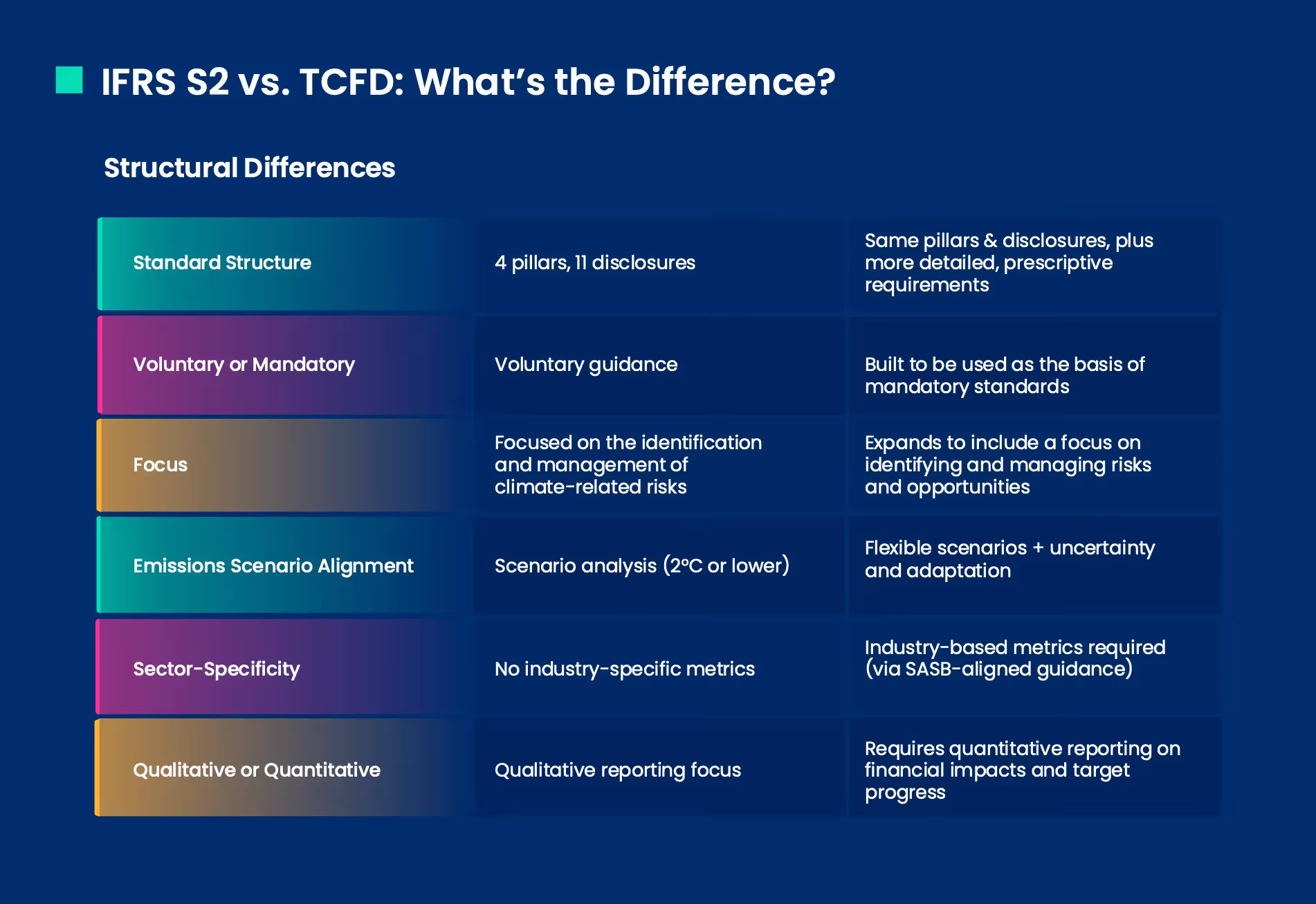
The bottom line is that you don’t need to disclose everything to be compliant in Year 1. As long as you have clear governance, a real risk process, strategy implications even if qualitative, the measures you are taking to reduce and adapt, and explain any gaps you likely will have, you will have met CARB’s “good faith” effort requirement for this reporting cycle.
What A Good Climate Risk Disclosure Looks Like: Traits to Emulate for SB 261 Compliance
Across our 100 reports, the average number of substantive disclosures was nine, against an average of four in comparable published research. This difference likely reflects our smaller sample and its skew toward larger, more mature companies that will likely come under SB 261.
Here are eight examples of what in-scope companies are actually publishing:
- Rogers Corporation
Industry: Manufacturing & Materials
Topics Disclosed: 6
In its 2025 Sustainability Report Supplement, Rogers TCFD-aligned disclosures detailed its climate risk governance structures and its integration within Enterprise Risk Management. They also present their Scope 1 and 2 emissions metrics, an intensity measure, and a public target (20% reduction by 2030, base year 2022). It also introduces an in-progress climate risk assessment with scenario analysis planned for completion in 2025. - Enerpac Tool Group
Industry: Manufacturing
Topics Disclosed: 6
In its 2024 Sustainability Report, Enerpac provides a TCFD Index where it outlines the company’s board and management oversight of climate matters, identifies demand- and weather-related risks, and highlights opportunities in clean energy and electrification markets. It discusses impacts on strategy and references business resilience planning. Enerpac also describes enterprise-level risk management integration. However, the company does not publicly disclose carbon emissions, does not provide scenario analysis, and lacks externally communicated climate-related targets. - Whirlpool
Industry: Manufacturing
Topics Disclosed: 8
In its 2024 Sustainability Report, Whirlpool provides a dedicated TCFD Index where it identifies climate-related risks and opportunities using scenario analysis, outlines governance structures including board-level oversight, and sets climate goals such as net-zero for Scope 1 and 2 emissions by 2030. However, Whirlpool lacks in the strategy topic and for addressing the financial impacts of climate risks topics. - Johnson Controls
Industry: Automotive Manufacturing
Topics Disclosed: 9
In its 2024 Sustainability Report and dedicated TCFD index, Johnson Controls discloses its governance practices. The strategy topic reporting integrates climate-related risks and opportunities into enterprise risk management and is supported by scenario analysis. Metrics and targets include Scope 1, 2, and 3 emissions, science-based interim targets, and a net-zero 2040 goal. However, financial impacts and long-term resilience analysis are less developed. - Mondelēz International
Industry: Food & Beverage
Topics Disclosed: 10
In its 2024 Snacking Made Right report, ESG Datasheet, Proxy Statement, and CDP Climate responses, Mondelēz outlines climate-related governance, risk management, and sustainability strategies. It provides a detailed TCFD index mapping disclosures to the 11 recommended areas for 2024 but is lacking in some resilience strategy responses. - Howmet Aerospace
Industry: Aerospace & Defense
Topics Disclosed: 11
In its 2025 TCFD Disclosure, Howmet delivers substantive, decision-useful reporting across all 11 TCFD areas. Governance is well integrated, with a strategy that includes quantified risk and opportunity analyses and scenario analysis tested across different climate pathways. Risk management is embedded in enterprise risk management, and metrics and targets are robust, featuring externally assured GHG data, intensity measures, and climate targets over the short and long term. - Gilead
Industry: Biopharmaceutical
Topics Disclosed: 11
In its 2024 report, Gilead has integrated climate considerations into its business strategy by setting robust decarbonization commitments, conducting scenario analyses of physical and transition risks, and publishing disclosure across all 11 TCFD topics. - Chubb
Industry: Insurance
Topic Disclosed: 11
Chubb’s fourth annual TCFD report outlines its science-based insurance approach to climate change. The company has a very mature approach to reporting aligned with the TCFD’s 11 topics, with Scope 1, 2, and 3 metrics reporting a net zero target. Chubb has a robust governance structure around climate risks and a well-developed structure for climate risk and opportunity assessments and strategies.
Throughout our research, we found two things correlated with higher topic coverage:
- Consecutive years of TCFD reporting and sector.
- The sectors the ISSB identified in its 2024 Progress Report as reporting against more elements also reported on more topics in our sample.
Map SB 261 To What You Actually Need to Publish in Year 1
The key thing to remember is that you only need to substantively report on the material elements of the eleven TCFD topics, the ones with a plausible financial impact on your business.
Our findings track the ISSB's progress report, which found US companies make substantive disclosures on four of eleven topics on average. Our number was higher, likely because our sample skews toward more mature companies.
Those four cluster around board oversight, GHG emissions, and the assessment of risks and opportunities.
North America Pillar Disclosure Rates in FY2023
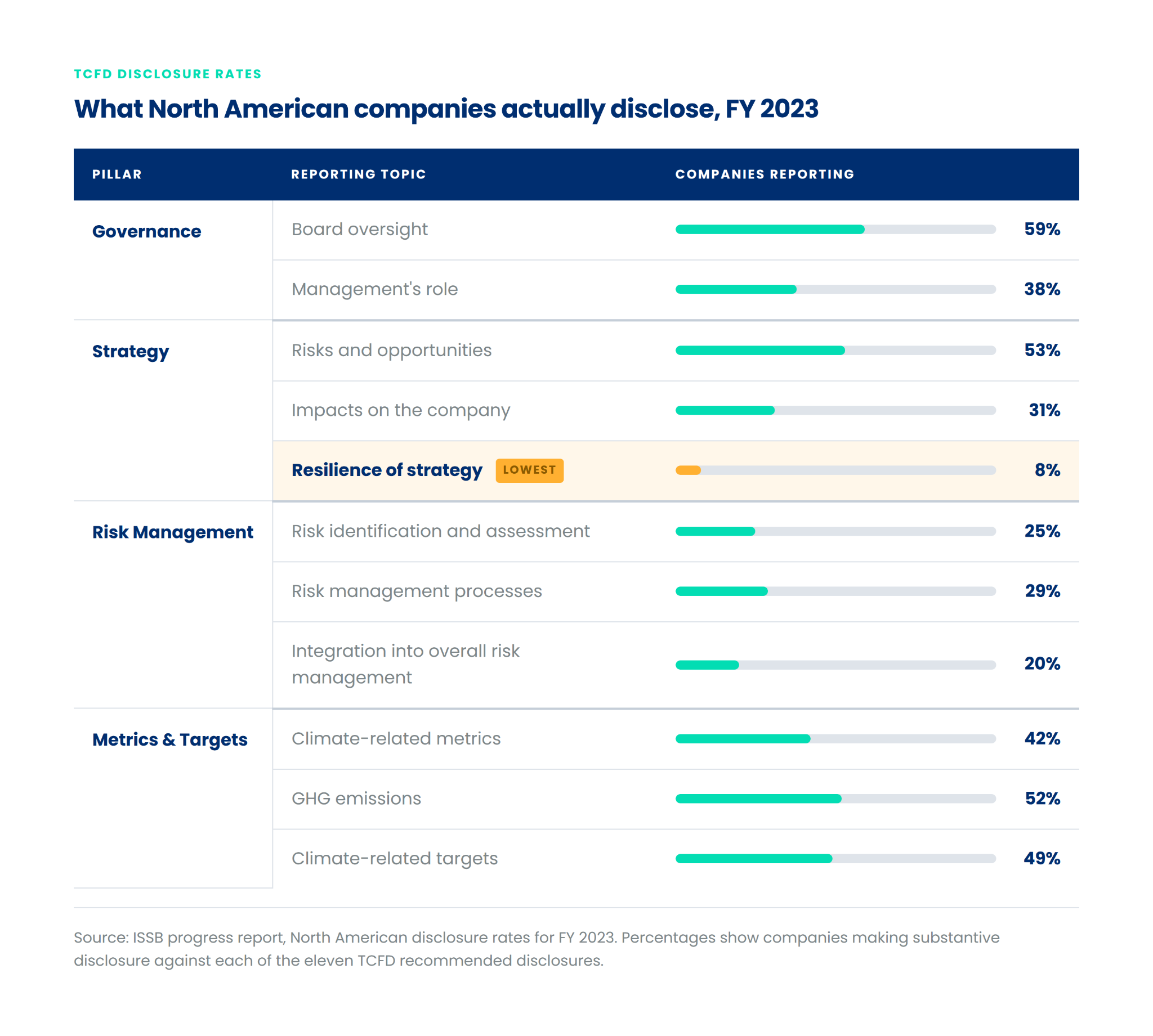
The complex parts of TCFD, like resilience and scenario analysis, both of which only 8% of companies did, are where almost nobody is, which means the bar for a credible first report is lower than most companies assume.
Our view is that substantive reporting on four to six material topics, anchored in board oversight, climate risk assessment, and targets, puts you in a position to explain the remaining gaps and outline plans to close them. That is what the statute requires and what ensures SB 261 compliance.
How Climate Risk Disclosure Varies by Industry
SB 261 does not require sector-specific data, but material risks differ by sector, with mature sectors disclosing more.
The ISSB progress report found:
- Six or more elements: Energy, Insurance, Manufacturing
- Three to five elements: Pharma, Retail, Tech
- Three or fewer: Consumer Packaged Goods, Financial Firms
If you are an energy company, a defensible “good faith” report looks different than it does for a consumer goods company, both in what your peers publish and in what your investors and customers expect to see.
What "Good Faith" Looks Like for a First Report
CARB has signaled it does not expect perfection in the first reporting cycle. Companies are still expected to identify and assess climate risks and opportunities and report them against the framework.
But they do have to either report or explain. You disclose what you can, explain what you cannot, and describe how you will close the gap.
A defensible first report needs:
- Governance you can evidence. A named board or internal climate committee, and climate risk appearing in the enterprise risk profile.
- A real risk identification process. The same process you use for other enterprise risks, with climate inputs.
- Qualitative strategy implications. What changes about your business if these risks materialize, and what do you plan to do about them?
- Honest gap disclosure. For everything above you cannot yet answer, provide the explanation and the timeline for fixing it.
The reporting period question on which fiscal year to use in reporting will depend on when CARB sets the new deadline, which will not be known until the appeal resolves.
The safe planning assumption is that you will use your most recently completed fiscal year at the time of filing, and that you will have less notice than you would like.
Good.Lab’s 5 Steps to SB 261 Compliance
At Good.Lab, we’ve refined our process by working with dozens of clients to prepare them for SB 261 compliance. Here’s how our Climate Regulation Solution guides you from start to finish:
1. Assess – We start with a rapid diagnostic against the four TCFD pillars: Governance, Strategy, Risk Management, and Metrics & Targets. A brief survey and interviews with up to five team members identify gaps in policy, data, and oversight. You get a quantified readiness scorecard on day one.
2. Benchmark – Our AI-powered research engine scans peer disclosures, TCFD filings, CDP responses, and annual reports so you can see where leaders in your sector are setting the bar. The result is a maturity range showing what minimum compliance looks like versus industry-leading. As the sector data above shows, that bar moves considerably by industry.
3. Roadmap – Each gap we identify becomes a clear, assignable, time-bound task. A working session with your team locks ownership and deadlines so progress survives the day-to-day workload.
4. Outline – A calibration workshop to define scope and ambition before drafting narrative themes, required metrics, and supporting evidence. This is also where the voluntary-filing question gets settled with your counsel.
5. Publish – We prepare a concise five-page TCFD-aligned report built for CARB's submission requirements, package the underlying worksheets, and guide your team through the upload.
We’ve worked with companies at all stages of TCFD maturity. Whether you're just starting or revising a first draft, our advice is the same: Be transparent, be specific, and don’t wait for perfect data to get started.
Beyond SB 261, Good.Lab handles the work underneath the report and broader compliance requirements: GHG emissions calculations for SB 253, target setting, and climate risk assessment filing, so your roadmap actions do not send you hunting for a second vendor.
––
The companies that will handle SB 261 well are not the ones waiting for the Ninth Circuit to overturn the injunction.
They are the ones using this period to document governance, run the risk assessment, and build the evidence base so that when a deadline arrives, publishing is a few clicks away.
The gap between those two positions is months of work. The notice period, when it comes, will likely be shorter.
If you are not certain whether you are in scope, or you know you are and cannot see a path to a credible report, that is the conversation to have now.