Customer Asked for Your EcoVadis Score? Here’s What That Means for Your Manufacturing Business
Andries Verschelden
Co-founder & CEO
Andries has had a variety of consulting and management roles throughout his career. He has worked with fast-scaling clients across three continents. Prior to founding Good.Lab, Andries led the blockchain practice at Armanino, a top 20 public accounting firm, was CEO at The Brenner Group, a boutique Silicon Valley financial services firm, and was a partner at Moore Stephens in Shanghai. He started his career at PricewaterhouseCoopers.
Andries holds his B.S. in International Politics from Ghent University in Belgium, an MBA from Binghamton University and founded and participated in the Moore Comprehensive Executive Leadership Program at Harvard Business School.
Perhaps the email asking for your EcoVadis score came from your customer’s procurement team, or you found it buried in a supplier onboarding form. Either way, it’s sitting in your inbox, and you’re not sure what to do with it. If you’re wondering what receiving an EcoVadis request as a manufacturer means for your business, you’re not alone.
More than 150,000 companies have been assessed by EcoVadis, and with 1,500 buyers using it as a supply chain assessment tool, these requests are becoming a standard part of doing business.
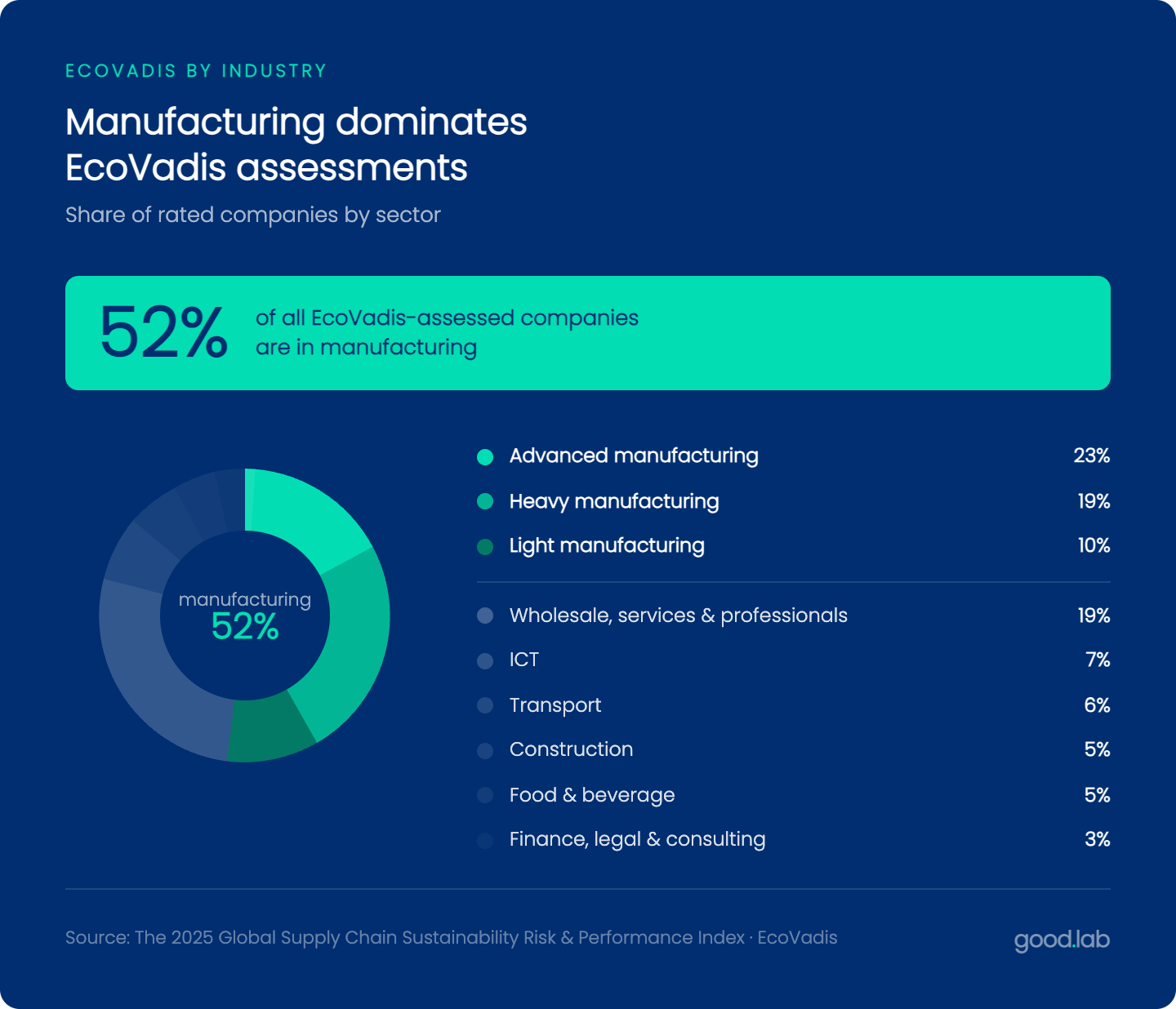
Manufacturers account for more than half of these EcoVadis assessments – more than any other sector combined. They’re also the sector receiving the most requests that haven’t yet been acted on. In this article, we’ll cover why manufacturers are being asked to report, what’s at stake if they don’t, and how to prepare.
What Is EcoVadis?
EcoVadis is a sustainability rating platform that scores companies from 0–100 across four sustainability themes: environment, labor & human rights, ethics, and sustainable procurement. It was founded in 2007 to bridge the information gap between corporate buyers and their suppliers, and today, it is the world’s largest sustainability ratings provider.
Your customers use that score the same way they use other certifications like SOC 2: as a qualifying factor in the supplier relationship. Medals are awarded to the top 35% of assessed companies. A score of 45 or above earns a Committed badge.
The process runs on a fixed cadence: three weeks to complete the questionnaire, six to eight weeks for EcoVadis analysts to review it, and a scorecard that remains valid for 12 months. Renewal is not automatic – each year, companies must submit a new questionnaire and provide updated documentation to maintain an active rating.
Why Manufacturers Get Asked To Report to EcoVadis More Than Anyone Else
The majority of a company’s energy use, waste, and environmental and social impacts flow through the manufacturers that produce what they sell or use. That visibility makes manufacturers the most common target for supply chain sustainability programs. According to EcoVadis, 52% of all companies it has ever assessed are in manufacturing – more than all other sectors combined.
That concentration reflects a simple dynamic: as enterprise buyers face growing pressure to account for their supply chain impacts, they pass that pressure downstream. EcoVadis assessments have surged 166% since 2020.
If you’re a manufacturer with large enterprise customers, you’re likely already feeling it. And that pressure is only going to increase.
What Happens If You Ignore an EcoVadis Request
Ignoring the request doesn’t make it go away. Deciding not to get assessed after receiving a request is a big risk. It signals to your customer that your company’s sustainability is a blind spot in their supply chain, and that you don’t intend to fix it.
Some buyers are already moving past requests and into mandates. Schneider Electric and automotive company Stellantis both require annual EcoVadis assessments from their tier 1 suppliers. They’re a preview of where procurement standards are heading.
The real cost of not doing EcoVadis is straightforward: losing a contract to a competitor who did.
The EcoVadis Process for Manufacturers, and Why Proper Documentation Is Everything
EcoVadis sends you a questionnaire tailored to your company’s size, geography, and sector. It covers 21 sustainability criteria across the four themes (environment, labor & human rights, ethics, and supply chain) and asks you to submit supporting documentation alongside your answers.
For most first-time reporters, the questionnaire itself can be confusing, but is actually not the hardest part. The much more difficult realization is that EcoVadis isn’t just scoring what you do – they’re scoring how well you can demonstrate it.
EcoVadis expects materials to be structured in a specific way. Evidence that doesn’t map clearly to their criteria is treated the same as evidence that doesn’t exist. For example, per their guidelines, they won’t credit informal documentation without a company name, logo, or issue date. Analysts will not follow embedded links or download additional files to find evidence you didn’t surface directly in the document itself. There’s also a hard limit of 55 documents per assessment, which means consolidation matters: bundling unrelated evidence into a single file to work around the cap is explicitly not accepted. And these are just the formatting rules – before you’ve answered a single question.
There’s a reason EcoVadis has an approved consulting partners program specifically to help companies complete the assessment. This isn’t a form you fill out in an afternoon.
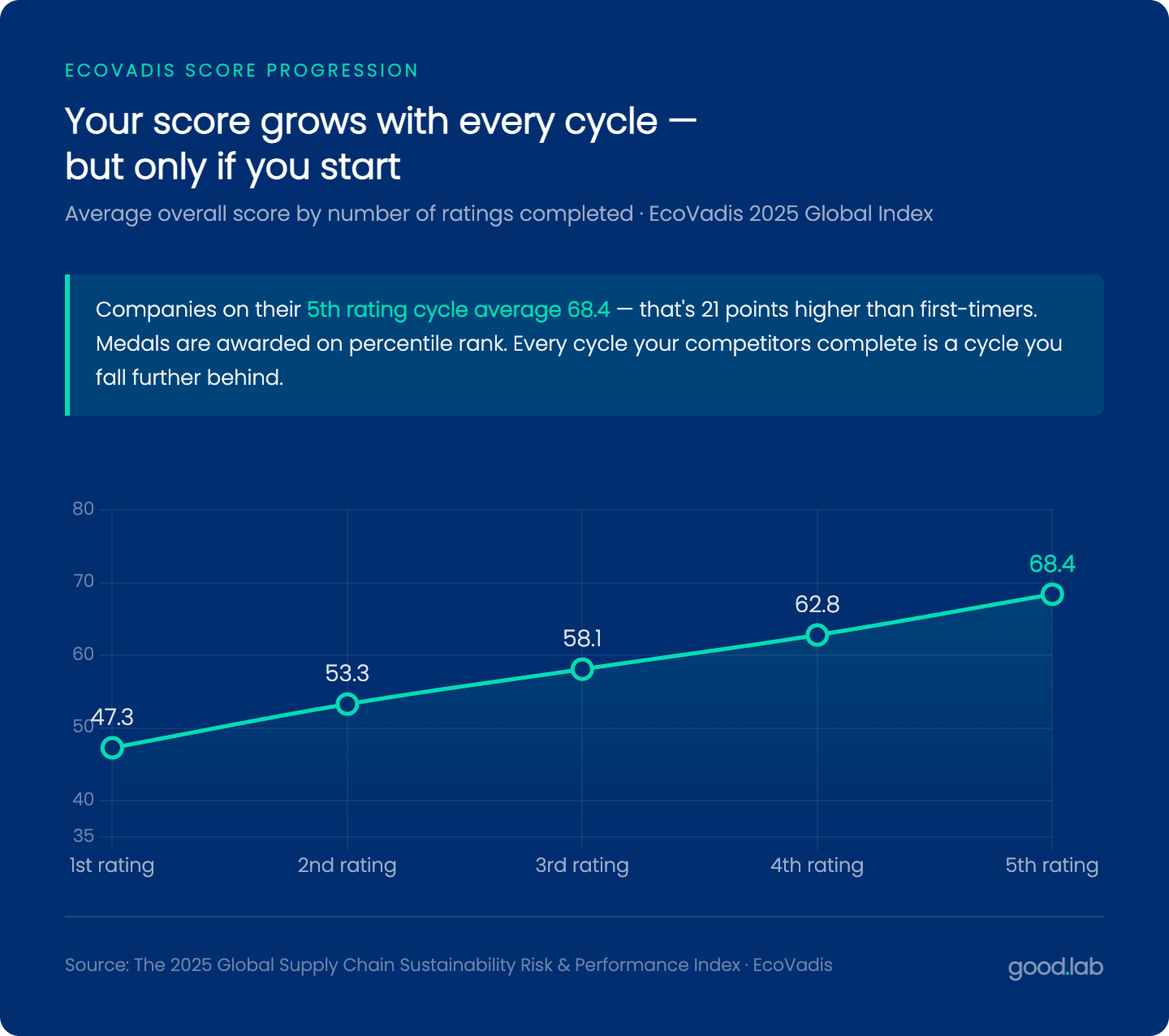
This is also why companies that report multiple times consistently score higher. EcoVadis provides specific feedback after each submission, and companies that act on it improve steadily. The average score gap between a first-time reporter and a fifth-cycle reporter is 21 points. That gap doesn’t close by accident.
Common EcoVadis Reporting Mistakes for Manufacturers
Every year, hundreds of companies get an insufficient score of 0-24. This means that they had incomplete or inaccurate reporting and documentation. The three most common reasons are:
Rushed documentation: If companies prepare their documentation reactively at the last minute, it will usually show, as it will be dated and may be underdeveloped.
Generic policies: Policies should be sector and company-specific.
Ignoring the scorecard feedback loop: Every scorecard reporter receives feedback on how to improve next year. Failing to follow that will result in the same or lesser score.
What a Good EcoVadis Score as a Manufacturer Gets You
With 1,500 enterprise companies using EcoVadis to evaluate their suppliers – and manufacturers making up the majority of those businesses – a strong EcoVadis score has real commercial value.
The main benefits of getting a score include:
Meet customer requirements. For many enterprise buyers, EcoVadis is no longer optional. GM, for example, requires its tier 1 suppliers to meet a minimum score of 50 across specific EcoVadis themes. Failing to meet a buyer’s threshold can put existing contracts at risk.
Win new business. A published score or medal makes you visible to buyers actively sourcing from EcoVadis-rated suppliers. Jakala, a data and AI company, attributes €37M in revenue to clients who actively monitor their EcoVadis performance – a figure that illustrates how directly a strong score can translate to commercial outcomes.
Get ahead of competitors. If your competitor hasn’t reported yet, a strong score is a differentiator. If they have, it’s how you pull ahead.
Identify risk before it finds you. The assessment process surfaces gaps in your sustainability management system: regulatory exposure, supply chain vulnerabilities, and operational inefficiencies – before a buyer or regulator does it for you.
For manufacturers receiving an EcoVadis request for the first time, the most common mistake is going straight to the questionnaire. Knowing how scoring actually works, and building the right documentation before you start, is what separates a strong first submission from a learning exercise.
Good.Lab helps manufacturers at that starting point. We’ve supported companies across multiple sub-sectors to prepare for and submit their EcoVadis assessments.
We know what EcoVadis analysts want to see from a manufacturing company, and we work with you to get the policies and documentation in place before you touch the assessment. Our clients improve their scores by an average of 25% through hands-on guidance.
Disclaimer: Good.Lab does not provide tax, legal, or accounting advice through this website. Our goal is to provide timely, research-informed material prepared by subject-matter experts and is for informational purposes only. All external references are linked directly in the text to trusted third-party sources.
Andries Verschelden
Co-founder & CEO
Andries has had a variety of consulting and management roles throughout his career. He has worked with fast-scaling clients across three continents. Prior to founding Good.Lab, Andries led the blockchain practice at Armanino, a top 20 public accounting firm, was CEO at The Brenner Group, a boutique Silicon Valley financial services firm, and was a partner at Moore Stephens in Shanghai. He started his career at PricewaterhouseCoopers.
Andries holds his B.S. in International Politics from Ghent University in Belgium, an MBA from Binghamton University and founded and participated in the Moore Comprehensive Executive Leadership Program at Harvard Business School.
Ready to elevate your sustainability efforts?
Connect with our sustainability experts today!
From sustainability program development to target setting, data management, and reporting, our team can help you fast-track building a world-class sustainability program.
CDP Reporting for Manufacturers: What to Do When a Customer Asks
The CDP portal opened on April 27th. If you received a customer request to disclose and you’re not sure what to do with it, here’s what you need to know. In 2025, of the 23,100+ companies who reported through CDP’s Supply Chain program, more than a third were manufacturers. And more than half of those […]
State Climate Reporting Laws: A Guide to US Climate Disclosure Laws
Federal climate disclosure rules may be stalled, but state climate reporting laws are not – and for large companies operating across the US, the compliance clock is already running. The situation is more manageable than it looks. Most state rules are built from the same blueprint: California moved first, and every state that followed used […]
Why the real AI risk has nothing to do with AGI Most conversations about AI risk focus on the future: superintelligence, mass unemployment, existential threats. That’s understandable and important, but it’s also a distraction. The most damaging AI failures companies face today have nothing to do with AGI. They are far more mundane, far more […]
Welcome to Good.Lab! We're glad you're here and want you to know that we respect your privacy and your right to control how we collect and use your personal data. Please read our Privacy Policy to learn about our privacy practices or to exercise control over your data.