


After a failed legal challenge, Oregon's packaging EPR law is now in full effect.
On August 27, 2026, a federal judge upheld the Plastic Pollution and Recycling Modernization Act and dissolved the injunction that had shielded some producers from enforcement. An appeal is pending, but it does not pause the law.
Producers selling packaged goods into Oregon should treat compliance as an obligation now, not as something pending litigation or a future worry. This article will tell you everything you need to know to comply.
👉 New to EPR? Start with our guide to US EPR laws for every state and come back for the Oregon specifics.
What does Oregon's EPR law require?
Oregon's EPR law, passed as SB 582 in 2021, requires producers of packaging, printing and writing paper, and food serviceware sold into Oregon to register with a producer responsibility organization (PRO), in this case the Circular Action Alliance (CAA), to report what they sell by material and weight each year, and pay fees. The program went live on July 1, 2025, making it the first in the US.
Who is affected by Oregon EPR?
Companies most likely to be in scope:
- Brand owners of packaged goods sold in Oregon, including food and beverage, personal care, and household products
- Importers and distributors of products whose brand owner has no US presence
- Retailers and e-commerce sellers that pack and ship orders into Oregon, for the boxes and fill they use
- B2B suppliers, since Oregon has no blanket exemption for commercial or transport packaging such as pallet wrap and shipping cartons
- Remote sellers with no physical presence in Oregon
Smaller producers could be exempt if they are below the following thresholds:
Revenue and tonnage count at parent company level, so a small subsidiary of a larger group usually does not qualify as a smaller company.
Oregon Department of Environmental Quality (DEQ)'s exemptions page lists all seven criteria and recommends that companies near a threshold register anyway. Some products are also exempt regardless of company size, including Bottle Bill beverage containers (caps included) and drug packaging.
Other thresholds change what you have to report, and the fees you pay two main ones to know are:
- Top 25 producers by weight must also publish annual life cycle evaluations.
- Low-volume producers may pay flat or tiered fees under CAA's program plan instead of full per-pound rates.
What do companies have to do?
Every obligated producer has to register, report, and pay. In practice, that breaks down into these steps:
- Confirm you are the obligated producer for each covered item. DEQ publishes a decision tree for this, and the answer can differ product by product.
- Check if you meet the exemption thresholds for small or low volume producer status.
- Register with CAA by signing its Producer Participant Agreement and the Oregon addendum.
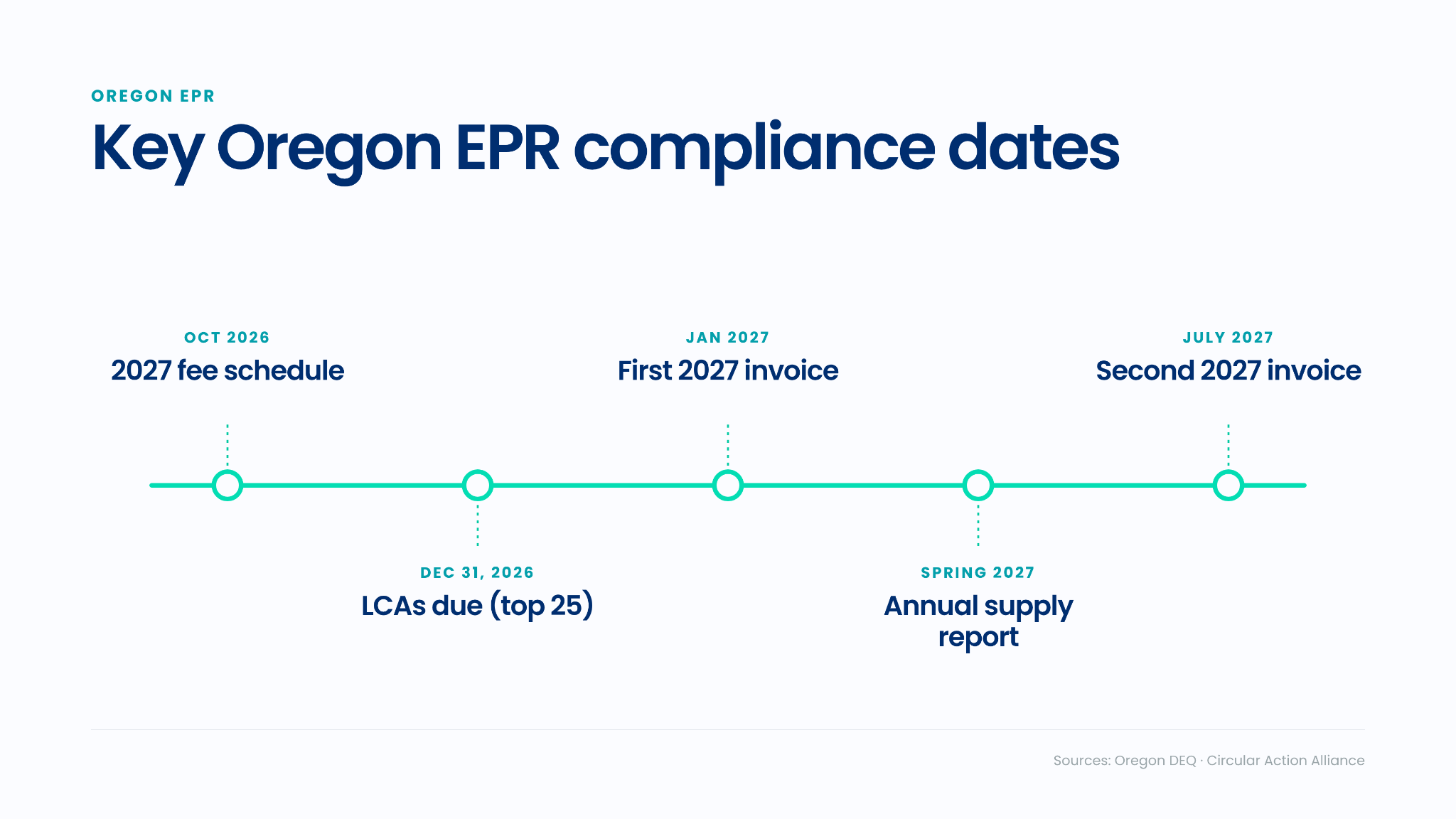
- Report annual supply data by material and weight through CAA's portal. Data for 2025 was due May 31, 2026, and will set 2027 fees.
- Pay fees on CAA's January and July invoice cycle.
- Claim the private recycling exemption if some of your material is recycled outside the curbside system. The window for the 2027 fee year closed March 31, 2026.
- Publish life cycle evaluations if you are one of the 25 largest producers by weight. The first are due December 31, 2026, and must be verified by a third party.
Failing to register this year is a Class 1 violation carrying fines of up to $25,000 per day, and DEQ has already named 250 allegedly noncompliant producers.
How do Oregon EPR fees work?
CAA sets Oregon EPR fees each year. They are calculated based on the total weight of packaging a company introduces into Oregon and charged per pound across roughly 60 material categories. Rates are eco-modulated, so material type and recyclability change what you pay.
Fees for 2027 are based on the 2025 supply data producers reported by May 31, 2026. Because rates reset annually and depend on everyone's reported tonnage, your bill can change even if your packaging doesn't.
Key Oregon EPR dates
How Good.Lab helps
Good.lab helps companies build the packaging data infrastructure to meet EPR requirements from a single source of truth, ensuring they can comply with other state rules simultaneously. For companies impacted by Oregon’s EPR law that work starts with three steps from the process we take clients through:
- Audit your packaging footprint. Map how much packaging you sell into Oregon by material and weight. This is the foundation of your CAA supply report and shows where your fee exposure sits.
- Centralize data collection. Oregon wants weight by material category, but other states ask for overlapping, non-identical fields. Designing one dataset up front means you are not rebuilding it for each new state.
- Redesign where it counts. Once you can see which materials drive your Oregon fees, you can prioritize packaging changes that lower them.
The full five-step approach is in our guide to EPR laws for every state. If you're trying to understand your Oregon exposure or get ahead of the next deadline, we can help.
With compliance to EPR laws the complex part is collecting and reporting the data: identifying every covered item, confirming you are the obligated producer for each, and reporting accurate weights by material.
Oregon is also one of seven states with packaging EPR laws, and each one asks for the same underlying data in a slightly different format. Build it once, and every new state gets easier.
You can see how Oregon compares to other states on our interactive EPR map.
Talk to good.lab about building a packaging data baseline that works across every EPR state.
Oregon EPR FAQ
Is Oregon's EPR law still in effect? Yes. A federal court upheld it on August 27, 2026. NAW has appealed, but the law remains enforceable during the appeal.
Who is the PRO in Oregon? Circular Action Alliance is the only DEQ-approved PRO.
Do small businesses have to comply? Not if they qualify as a small producer, for example with under $5 million in global revenue or under one metric ton of covered products sold into Oregon.