



Extended Producer Responsibility (EPR) laws are expanding rapidly across US states. Seven states have now adopted some form of packaging waste rule that requires businesses to register with a Producer Responsibility Organization (PRO), report their covered waste streams, and pay fees.
Because there is no current federal standard, companies face a fragmented patchwork of state-by-state compliance requirements, necessitating a proactive, nuanced strategy to minimize fees and avoid hefty fines.
The challenge isn't just understanding each rule. It's building packaging data in a format that works across all of them simultaneously. This guide breaks down every active law, what they require, and how to prepare.
What Are Extended Producer Responsibility (EPR) Laws?
EPR rules shift the cost of waste from governments and consumers to producers. They follow the polluter-pays principle and are designed to financially incentivize producers to “eco-modulate” their products, reduce post-consumer waste, increase circularity, and redesign products to be more sustainable.
In the US, EPR rules mainly cover packaging and paper products, but their scope is expanding. For the majority of US state-level rules, an “obligated producer” is required to join a Producer Responsibility Organization (PRO), typically operated by the NGO the Circular Action Alliance.
The PRO acts on behalf of producers to report their covered waste, pay fees, and manage the products' end-of-life. Obligated producers are typically the brand or manufacturer producing the materials, or an importer that produces a covered product over a threshold.
Why EPR Laws Are Expanding in the US
A federal EPR law (Packaging and Claims Knowledge Act) was proposed in 2025. However, it is unlikely to pass as federal action on sustainability has stalled.
That leaves the states to pick up momentum and take action against the growing cost of waste, stagnating recycling rates, and pollution.
These rules will shift the financial burden onto the producers, incentivizing them to reduce the volume of their waste, redesign their products, and consider the recyclability of their materials.
Key Compliance Requirements for Businesses: Who is an “Obligated Producer”?
Every active US packaging EPR law shares a common structure: mandatory PRO participation, annual reporting, eco-modulated fees, and escalating recyclability targets. But before any of that, companies need to answer a more basic question: do these rules apply to you at all?
Most states distinguish between three tiers of packaging:
- Primary packaging: what consumers see on shelves
- Secondary packaging: outer shipping boxes
- Tertiary packaging: pallet wrap and transport materials
Which tiers are covered, and who in the supply chain is responsible for each, varies by state. Colorado covers only primary packaging; secondary and tertiary are out of scope entirely. California holds the retailer responsible for the full packaging chain, which shifts significant liability downstream but at least makes clear who owes what. Other states land somewhere in between, and the obligated producer for a single shipment can differ depending on which component you're looking at.
If your packaging never reaches consumers directly, don't assume you're exempt. The answer depends on which states you sell into and how each one defines covered materials and producer responsibility.
The data infrastructure difficulty
Once you've confirmed your obligations, the hard part isn't reading the rules. It's building the data infrastructure to satisfy all of them at once. Each state requires overlapping but non-identical information:
- Oregon wants weight by material category
- Minnesota requires reporting by covered material type
- California tracks plastic components separately
Companies that try to piece this together retroactively, under a registration deadline, pay more and scramble more than those that build it correctly from the start.
Good.Lab helps companies work through every step of this: from determining obligations and mapping packaging footprints, to building a dataset that satisfies various state requirements. If you want to understand your exposure before you get there, talk to us.
The state-by-state breakdown below covers what each law requires and when.
Where EPR Laws Stand by State (2026)
State-by-State Breakdown of EPR Laws
EPR California
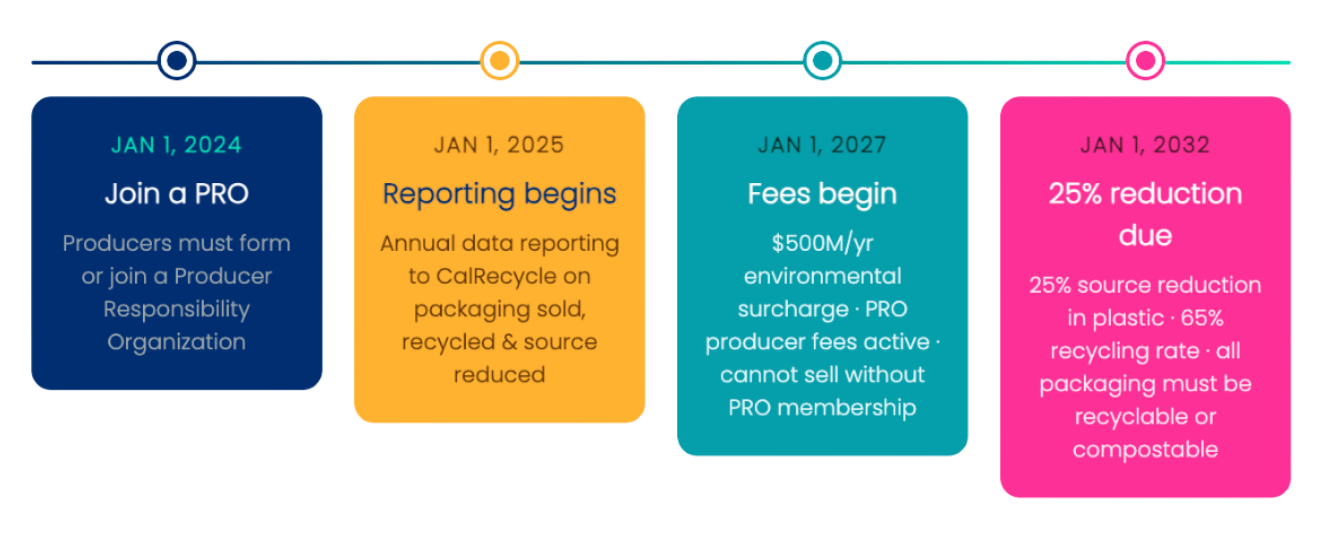
California’s SB 54 will have the biggest impact on companies, given California’s economy and population, and it is one of the strictest. It is being phased in from 2024, when covered companies are required to join a Producer Responsibility Organization (PRO).
Timeline:
- Status: California adopted the rule in 2022.
- Covered companies: Any manufacturer, brand owner, importer, or distributor selling covered products in California.
- Exemptions: Companies with under a $1 million in sales in CA and certain packaging exemptions (e.g., agricultural and hazardous packaging)
- Covered products: Single-use packaging and Plastic single-use food serviceware with specific carve-outs for packaging that already meet recycling rates and hazardous materials. California is also expanding its EPR coverage to include textile waste under SB 707.
- Key requirements:
- Join a PRO by 2024.
- By January 1, 2025: report weight and number of single-use plastic, paper/fiber, glass, metal, and other material components sold in CA, total plastic recycled by material category.
- By May 31, 2026: report source reduction actions taken vs. 2023 baseline.
- By 2027: pay a portion of the $500 million annual fee based on your percentage share of total covered plastic waste by weight.
- By 2032: reduce source plastic by 25% and achieve a 65% recycling rate.
- Fees and Penalties:
- Fees include the PRO membership fee, a percentage of the $500 million annual surcharge based on the obligated producer’s plastic waste market share, and additional administrative fees.
- Penalties for non-compliance can run up to $50,000 per day.
EPR Oregon
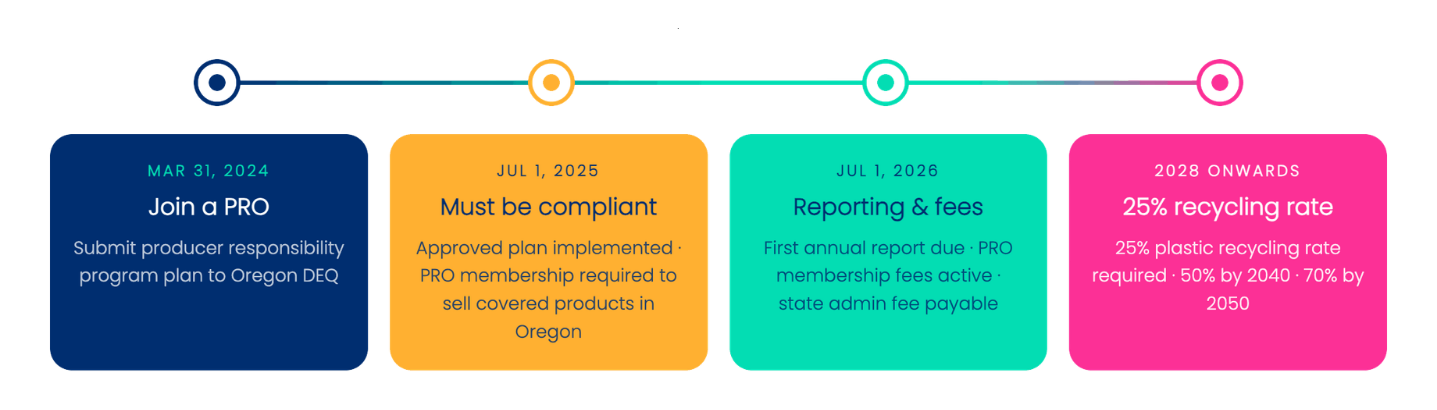
Oregon’s SB 582 was the first EPR rule to set up the system that other states, including California and Colorado, have now emulated. It has been getting phased in since March 31st 2024 when companies were required to join a PRO.
Timeline:
- Status: Adopted in July 2021.
- Covered companies: Any manufacturer, brand owner, importer, or distributor selling covered products in Oregon.
- Exemptions: Companies with gross revenue under $5 million, sold less than 1 metric ton of covered products into Oregon, single-location retailers with no online sales, restaurants not manufacturing food service ware, nonprofits, and public bodies.
- Covered products: Three categories — packaging, printing and writing paper, and food service ware. Specific carve-outs for beverage deposit containers, agricultural and hazardous packaging.
- Key requirements:
- Join a PRO by March 31, 2024.
- By July 1, 2025: Compliance begins, must have an approved waste plan.
- By July 1, 2026, submit first annual report covering weight and type of covered products sold, recycling performance, financial summary, and materials disposition.
- Achieve 25% plastic recycling rate by 2028, 50% by 2040, and 70% by 2050.
- Fees and Penalties: Fees include the PRO membership fee (set by material type, recyclability, and environmental impact), and fees related to managing waste. Penalties for non-compliance range up to $25,000 per day, and can lead to state bans for non-compliant products.
EPR Colorado
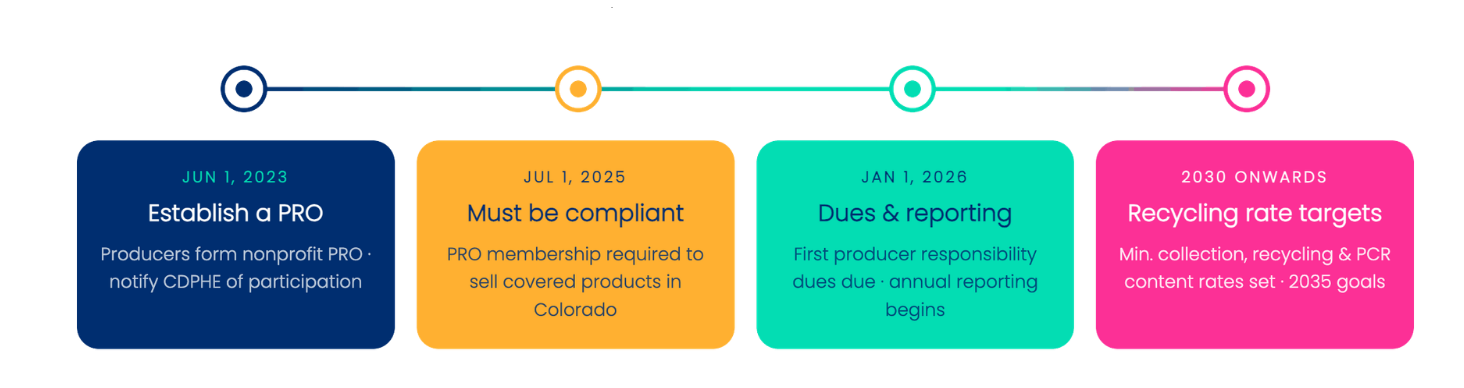
Colorado's HB 22-1355 covers both packaging materials and paper products, making it more comprehensive than Oregon's program. Adopted in 2022, it has been phased in since mid-2023.
Timeline:
- Status: Colorado adopted the rule in 2022.
- Covered companies: Any manufacturer, brand owner, licensee, importer, or distributor selling covered products in Colorado.
- Exemptions: Companies with under $5M in gross annual revenue, those using less than one ton of covered materials in Colorado, nonprofits, state and local governments, agricultural employers under $5M in in-state consumer sales, individual retail food establishments, and builders/construction companies.
- Covered products: Packaging materials and paper products. Carve-outs include pharmaceutical, agricultural, and other hazardous packaging.
- Key requirements:
- Establish a nonprofit PRO and notify the Colorado Department of Public Health and Environment (CDPHE) by June 1, 2023
- By July 1, 2025: producers must be participating in the PRO to legally sell covered products in Colorado
- By January 1, 2026: pay annual producer responsibility dues based on material type, recyclability, and market share of covered waste
- 2030 onwards: meet minimum collection rates, recycling rates, and post-consumer recycled content (PCR) targets set in the final plan
- Fees and Penalties:
- Fees vary by covered material type and whether materials are readily recyclable — harder-to-recycle materials pay more. An eco-modulation system further adjusts fees based on packaging design, post-consumer recycling content, and circularity. In addition to PRO fees.
- Penalties for non-compliance range from $5,000 to $20,000, plus $6,000/day depending on the severity.
EPR Maine
Maine's LD 1541 was the first packaging EPR law passed in the United States, signed in 2021 and meaningfully amended in 2025 (LD 1423). Unlike California, Oregon, and Colorado, which use a PRO model, Maine runs its program through a regulated utility (stewardship organization) rather than a producer-managed nonprofit, and the fees reimburse waste municipalities.
Timeline:
- Status: Adopted 2021, amended June 2025.
- Covered companies: Any manufacturer, brand owner, licensee, importer, or distributor selling packaged products in Maine.
- Exemptions: Under $2M in gross annual revenue (rising to $5M during the first three years of program operation), under one ton of packaging used in Maine, salvage/liquidation businesses deriving more than 50% of revenue from such sales, and a first-15-tons exemption for perishable food packaging (amended from the original full exemption). Nonprofits are excluded entirely.
- Covered products: Packaging materials only — paper, plastic, glass, metal, cartons, flexible foam, rigid packaging. Excludes long-term protective packaging (5+ year durable goods) and some hazardous packaging.
- Key requirements:
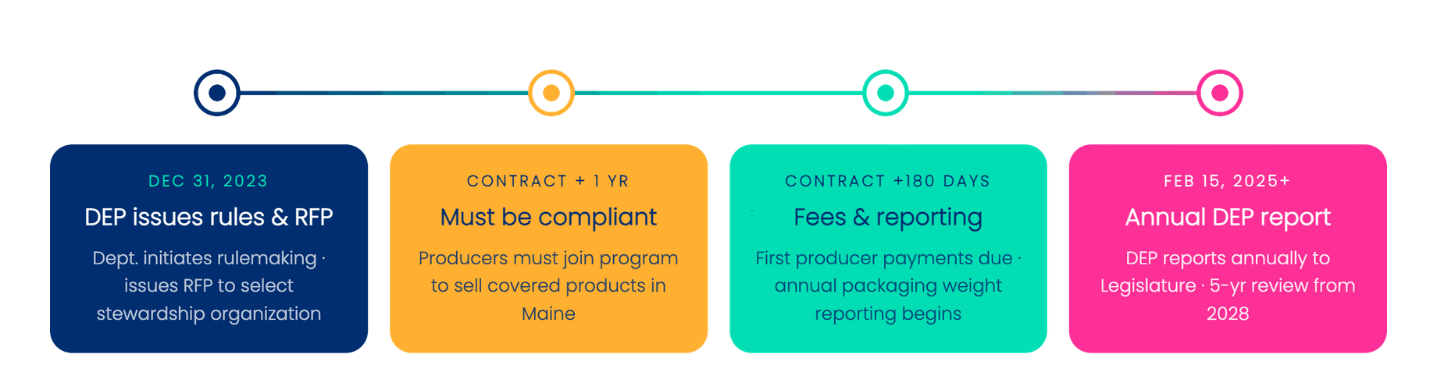
- Maine’s Department of Environmental Protection (DEP) must initiate rulemaking and issue an Request for Proposal (RFP) to select a stewardship organization by December 31, 2023
- Once a contract is executed, producers have one year to comply or they cannot legally sell covered products in Maine
- Within 180 days of contract execution, producers must make their first annual payments to the stewardship organization, based on the weight and type of packaging sold in Maine.
- Beginning February 15, 2025, DEP submits an annual report.
- Fees and Penalties:
- Producer payments vary by material type and recyclability. Low-volume producers pay a capped flat fee of no more than $500/ton and $7,500/year total. The stewardship organization pays DEP an annual oversight fee capped at $300,000 to reimburse waste municipalities.
- Penalties for non-compliance are decided by the DEP on a case-by-case basis.
EPR Maryland
Maryland's SB 901 covers both packaging materials and paper products, making it one of the broader state EPR laws enacted to date. Signed May 13, 2025, it applies to any producer selling covered products in Maryland, with compliance obligations phasing in through 2030.
Timeline:
- Status: Adopted in 2025
- Covered companies: Brand owners, item manufacturers, licensees, importers, and first distributors selling covered products in Maryland.
- Exemptions: De minimis producers (under 1 ton of covered material introduced into the state OR under $2M in global gross revenue), non-profits, government entities; single-location retailers.
- Covered products: Packaging materials and paper products. Carve-outs for non-consumer packaging, medical, and other hazardous packaging.
- Key requirements:
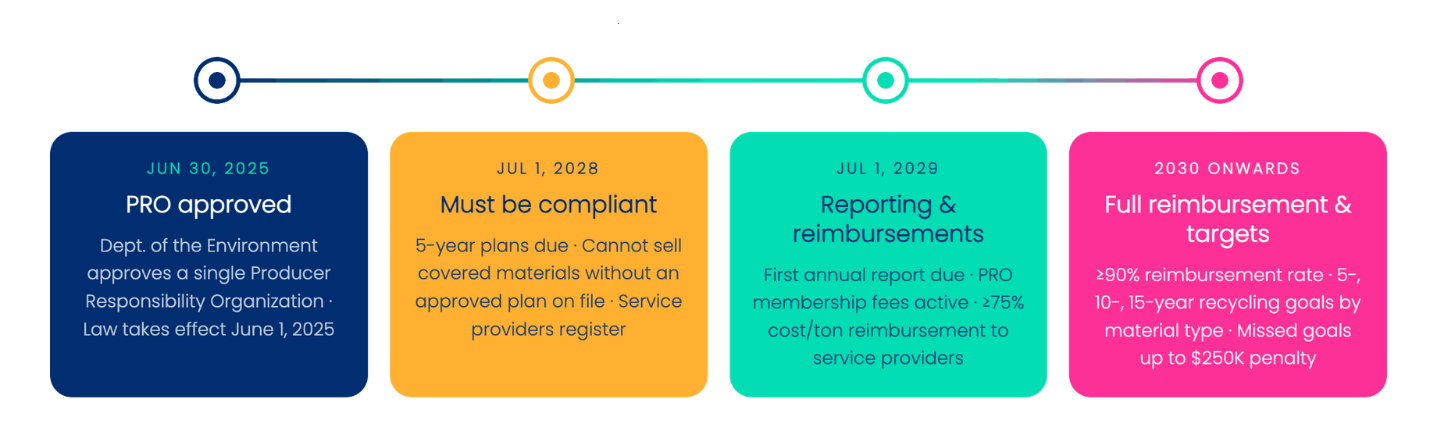
- Department approves a single PRO by June 30, 2025.
- PRO files annual registration beginning July 1, 2026, including a list of participating producers, brands, and covered materials.,
- Department publishes statewide list of recyclable and compostable materials by July 1, 2027.
- Each producer, individually or through a PRO, submits a 5-year Producer Responsibility Plan to the Department by July 1, 2028.
- Annual reporting begins July 1, 2029.
- Reimbursement ramps up to 90% by July 1, 2030, and each year thereafter.
- Fees and Penalties:
- Producer fees are set by an eco-modulated fee structure, with higher fees for low-recyclability or low-recycled-content materials. Fees must cover PRO and reimburse municipalities for their share of the cost for that year, 70% in 2028, ramping up to 90% in 2030.
- Penalties for non-compliance range from $5,000 and $20,000 daily, depending on the severity. PROs that miss performance goals face administrative penalties up to $250,000.
EPR Washington
Washington SB 5284 was adopted in 2025 and will be phased in from 2026. It covers
Timeline:
- Status: Adopted in 2025.
- Covered companies: Any producer, manufacturer, brand owner, importer, franchisor, or first distributor selling covered packaging or paper products in Washington.
- Exemptions: De minimis producers (under 1 ton introduced and under $5M global gross revenue, or qualifying agricultural employers), non-profits, and government agencies.
- Covered products: Consumer packaging (all materials) and paper products sold to consumers for personal, noncommercial use. Carve-outs include pharmaceutical packaging, infant formula packaging, other hazardous materials, and packaging already achieving 65%+ recycling rates in commercial settings.
- Key requirements:
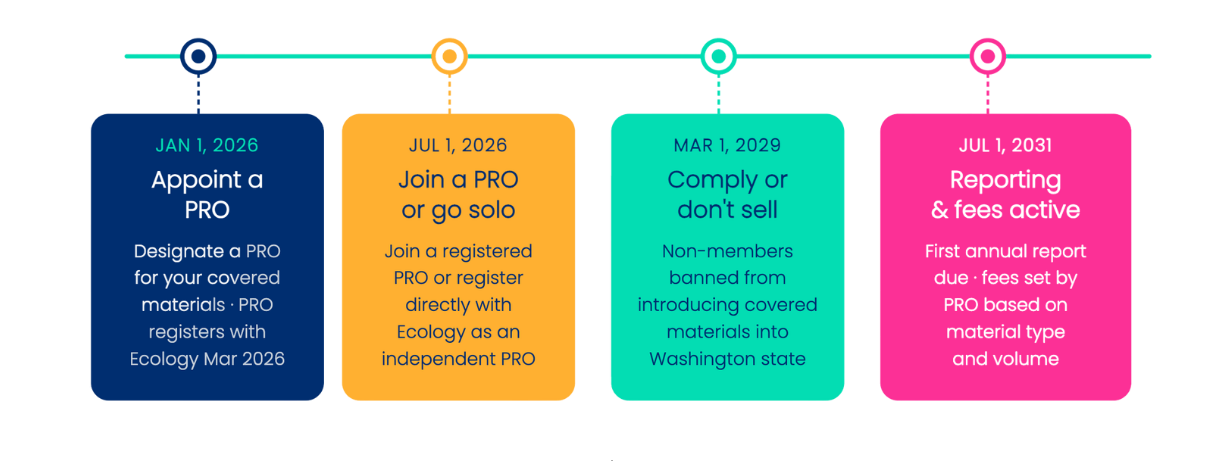
- By January 1, 2026: Appoint a PRO to manage your covered packaging and paper products.
- By March 1, 2026: Ensure your PRO is registered with the WA Dept. of Ecology.
- By October 1, 2028: PRO submits first 5-year plan to Ecology.
- By March 1, 2029: Non-PRO members may not sell covered materials in Washington
- By July 1, 2031: First annual report due to Ecology covering volume of covered materials introduced, progress against performance targets, program costs, and an independent financial audit
- Fees and Penalties:
- Producer fees are set by the PRO and are eco-modulated, incentivizing recyclable design, source reduction, and PCR content use, while penalizing harder-to-recycle materials.
- Civil penalties for non-compliant producers range from $1,000/day for first violations, up to $10,000/day. Retailers distributing non-compliant brands face penalties of twice the value of covered materials sold or $500, whichever is greater.
EPR Minnesota
Minnesota's HF 3911 establishes the Packaging Waste and Cost Reduction Act, covering both packaging and paper products. Signed in 2024, it applies to any producer selling covered materials in Minnesota, with compliance obligations phasing in through 2032.
Timeline:
- Status: Adopted in 2024.
- Covered companies: Brand owners, item manufacturers, licensees, importers, and first distributors selling covered products in Minnesota.
- Exemptions: De minimis producers (under 1 ton of covered material introduced into the state OR under $2M in global gross revenue), non-profits, government entities, producers already meeting recycling post-consumer targets.
- Covered products: Packaging and paper products. Carve-outs for B2B-only packaging and certain hazardous materials packaging
- Key requirements:
- Producers must appoint and join a PRO by January 1, 2025.
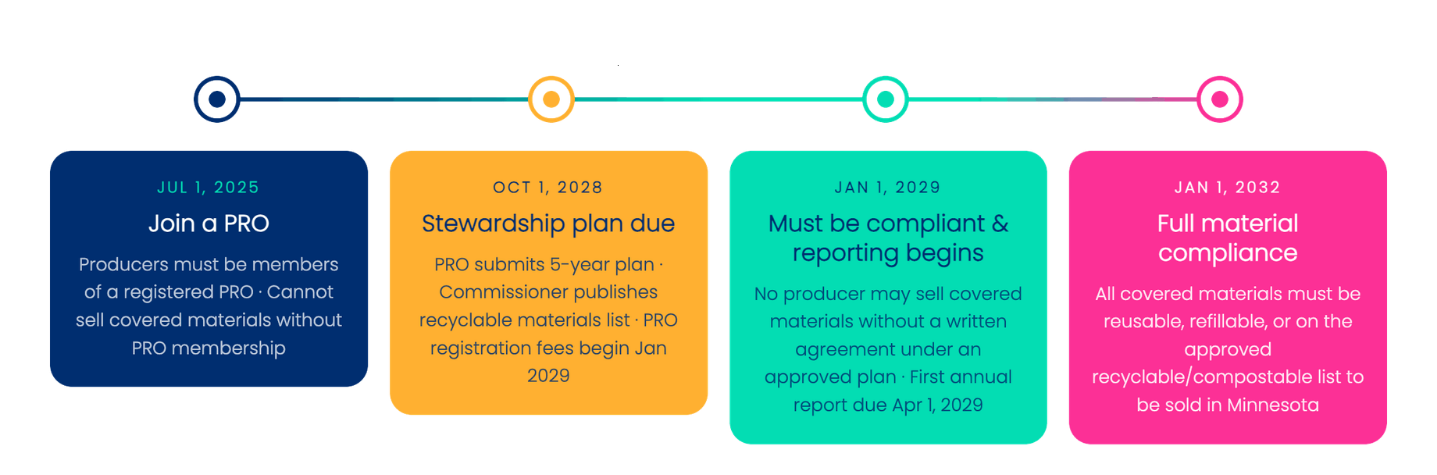
- After July 1, 2025, producers must be members of a registered PRO, or they cannot sell covered materials in Minnesota.
- Commissioner provides recyclable/compostable materials lists to PROs by July 1, 2028
- After January 1, 2029, no producer may sell covered materials without a written agreement to operate under an approved stewardship plan
- First annual report due April 1, 2029; annually thereafter
- PRO reimburses service providers ramp up annually from 50% in 2029 to by 90% by February 1, 2031, and each year after.
- After January 1, 2032, all covered materials must be reusable, refillable, or included on the approved recyclable/compostable list to be legally sold in Minnesota
- Fees and penalties:
- Producer fees are eco-modulated, based on the amount of covered material introduced and based on volume. Reusable materials are charged only once upon initial entry into the market. Fee revenue must cover service provider reimbursements (90% by 2031), PRO operating costs, registration fees, and a financial reserve.
- Penalties range from $25,000 to $100,000 per day depending on severity and repetition of non-compliance.
- Producer fees are eco-modulated, based on the amount of covered material introduced and based on volume. Reusable materials are charged only once upon initial entry into the market. Fee revenue must cover service provider reimbursements (90% by 2031), PRO operating costs, registration fees, and a financial reserve.
State EPRs in Progress
There are also multiple other additional states with rules currently going through the legislative process. Many of these could see movement in 2026 and be adopted soon. The primary ones most likely to pass include:
- New York: New York's A1749/S1464 is currently making its way through the legislative process, if passed in its current form, it would require producers to register with a PRO within 18 months of enactment, meet escalating packaging reduction targets of 10–30% over 12 years, and hit recycling rates of 25–75% depending on material type, with penalties of up to $1,000 per day per non-compliance.
- Massachusetts: Massachusetts’s H.926 if passed in its current form would require producers to register with a state-contracted nonprofit PRO within one year of its selection, meet escalating packaging reduction targets of 10–50% by weight over ten years, and hit recycling rates of 30% within five years, 50% within eight years, and 70% within twelve years of enactment, with civil penalties of up to $100,000 per day per product line for non-compliance.
- New Jersey: New Jersey's S3398 if it clears the full legislature in its current form, it would require producers to join a single state-approved PRO within one year of enactment, meet escalating single-use plastic source reduction targets of 10–50% over ten years, ensure all packaging is recyclable or compostable by January 1, 2034, and hit a 65% recycling rate by January 1, 2036, with penalties of $5,000–$10,000 per violation per day.
- Hawaii: Hawaii took a different approach entirely rather than jumping straight to a full EPR mandate, the state enacted HB750 in May 2025 (Act 103), which appropriates $1 million to fund a statewide EPR needs assessment through the Department of Health, with results and any proposed legislation due to the legislature by December 31, 2028, meaning any actual producer compliance will be could be advised but is still several years away.
These are just the broad rules for packaging and paper. There are more specific EPR rules for tires, batteries, textiles, and many other products that are both already passed and working through state legislatrues.
The Cost of EPR Compliance
Fee structures vary by state, but the cost drivers are consistent across all of them: material type, volume, and recyclability.
Harder-to-recycle materials cost more. Higher market share means higher fees. And eco-modulated structures mean your packaging design decisions today directly affect what you pay in 2028, 2029, and beyond.
The expense most companies underestimate isn't the PRO membership fee. It's the data infrastructure required to comply.
Each state requires overlapping but non-identical packaging data, and building a dataset retroactively to satisfy seven different state requirements is significantly more expensive than building it once, correctly, from the start.
How to Prepare for EPR Laws Now
Facing a patchwork of state-level rules, companies will have to take a proactive approach to both reduce their fee exposure and potential penalties. This is the five-step process Good.Lab takes our clients through:
Step 1: Audit your packaging footprint: Map how much packaging you send or sell in each EPR state. This will help you understand potential exposure and prepare to eco-modulate products to reduce fees. This audit is also the foundation of your PRO registration data, so building it now saves you from having to do it twice under a tight deadline.
Step 2: Centralize data collection: Most EPR statutes require overlapping but non-identical data fields. Oregon wants weight by material category, Minnesota wants by covered material type, and California tracks plastic components separately. Building a dataset that satisfies all states requires an intentional data-collection design upfront.
Step 3: Engage with a PRO early: Joining a PRO, such as the Circular Action Alliance early gives producers more influence over how fee structures and reporting requirements are written, more time to redesign packaging before baselines are set, and a lower cost profile from day one companies that register late inherit rules, data schemas, and fee structures built by someone else, often at a higher price and with less ability to influence how those rules are applied to their products.
Step 4: Redesign packaging: The biggest lever for reducing fees and ensuring long-term compliance is to begin redesigning your products as early as possible, considering materials and every stage of the product life cycle to ensure reusability or recyclability.
Step 5: Get your data infrastructure right from the start: The companies that will pay least under these rules are the ones that built a single packaging dataset covering material type, weight, recyclability, and volume by state before they needed it, not after their first PRO registration deadline.
—
With potentially more than a dozen states set to have EPR laws in place in the coming year, waiting for rules to finalize is not a good option.
The companies that move early and treat this as a strategic issue now, auditing their packaging footprint, building clean data, and joining PROs before baselines are set, will pay materially less than those that don't.
Good.Lab helps companies build the packaging data infrastructure to satisfy all state requirements from a single source of truth. If you're trying to understand your exposure or get ahead of the next deadline, we can help.