



Major retail suppliers are increasingly being asked to complete sustainability questionnaires. Not responding is a risk most can't afford.
If a supplier sustainability questionnaire just landed on your desk, you're not alone. Walmart, Amazon, Costco, and other major retailers now make this a routine part of doing business with suppliers, whether it arrives through CDP, EcoVadis, or a customer's own spreadsheet.
Most focus on the same things: emissions reporting and reductions, governance practices, and environmental and social performance overall. The details vary, but that core rarely does.
Here's what these questionnaires actually ask for, why retailers send them, and how to respond in a way that protects the relationship instead of putting it at risk.
What is a Supplier Sustainability Questionnaire?
A supplier sustainability questionnaire, also known as a supplier sustainability assessment, ESG questionnaire, or vendor questionnaire, is how large buyers collect the sustainability information they need from suppliers. It also motivates suppliers to act on it. Some come from established reporting frameworks; others are custom-built by the buyer.
Historically, these came as a company portal or a custom spreadsheet. More recently, many are hosted on third-party frameworks like CDP or EcoVadis.
They cover the sustainability information a customer needs from suppliers to measure Scope 3 emissions, track progress against targets, and understand risk exposure.
Why Walmart, Amazon and Other Major Retailers Send Supplier Sustainability Questionnaires
Large retailers send supplier sustainability questionnaires for three main reasons:
To Understand, Manage, and Find Scope 3 Emissions
Most of a retailer’s emissions sit outside its own operations and are associated with the products it purchases, how those products are manufactured and packaged, and how they are transported and used. These emissions across the value chain are called Scope 3. Walmart’s Scope 3, for example, is more than 95% of its emissions, and Amazon’s is 75%.
Retailers therefore need information from suppliers to calculate their Scope 3 emissions accurately, identify their biggest sources of impact, and measure progress against their climate goals.
To Meet Regulatory and Stakeholder Expectations
Retailers face growing pressure from regulators, investors, customers and other stakeholders. They're expected to show credible information about environmental and social risks across their value chains.
A supplier questionnaire helps the retailer demonstrate that it is actively assessing and mitigating those risks. It also helps companies build the supplier engagement processes needed to improve Scope 3 reporting under regulations such as the California Climate Rule in 2027. While companies can initially rely on spend-based and other secondary data, supplier-specific data generally provides a more accurate picture of emissions over time, and may be required in future iterations.
To Deliver Company Sustainability Programs
Retailers also use supplier data to operate their own sustainability initiatives.
- Walmart launched Project Gigaton to engage suppliers in reducing or avoiding one billion metric tons (1 MT) of greenhouse gas emissions across its value chain. It already met the goal six years early. Suppliers report actions annually and benefit from preferred financing options and other incentives.
- Amazon has committed to reaching net-zero carbon emissions by 2040 through its Climate Pledge. It also encourages high-emitting suppliers to join the pledge and offers incentives like preferred pricing to signatories.
The exact request will depend on the retailer and the supplier relationship, but the purpose is usually the same: the customer needs credible information to understand its supply chain sustainability-related risks and make better procurement decisions.
Where Supplier Sustainability Questionnaires Come From
Supplier sustainability questionnaires generally arrive in one of three ways.
A Customer-Specific Questionnaire
Some retailers use their own spreadsheets, online portals, or annual supplier surveys. These are usually tailored to the company’s goals and may ask for specific information such as emissions, packaging volumes, certified materials, labor practices, or responsible-sourcing controls.
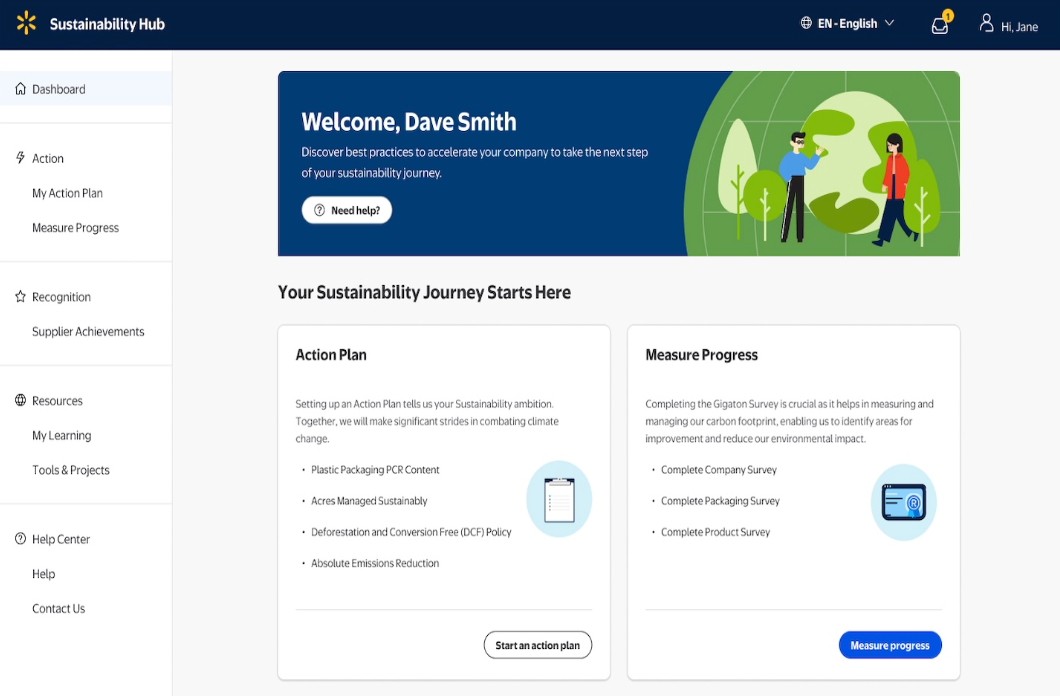
Walmart, for example, provides suppliers with a Sustainability Hub, a simple platform where suppliers can provide an action plan, measure their progress, get education, and connect to the Project Gigaton initiative.
A Third-Party Disclosure Platform
Retailers may ask suppliers to disclose through platforms such as CDP or EcoVadis.
CDP focuses primarily on environmental information: climate change, water, forests, biodiversity and plastics. In 2025, approximately 45,000 suppliers were asked to disclose through CDP by more than 270 major buyers.
EcoVadis covers a broader assessment: environment, labor and human rights, ethics, and sustainable procurement. Amazon requests some of its major suppliers to report to EcoVadis, and allows businesses to post their EcoVadis medal or badge on their seller pages.
👉 See how Good.Lab helped Pallet Recovery Service (PRS) meet an urgent Amazon EcoVadis request.
A Supplier Code or Contractual Requirement
Some requests are embedded in a supplier code of conduct, contract, procurement standard or onboarding process. These typically cover emissions, environmental management, worker rights, business ethics, and ongoing disclosure.
Amazon and Costco, for example, publish supplier standards that form part of their expectations for doing business.
What a Supplier Sustainability Questionnaire Typically Asks
The questions vary, depending on where the ask comes from, who is asking, and to whom, but most assessments cover a similar group of topics.
A questionnaire may ask whether a program exists, but a strong response normally requires back-dated evidence. Policies, records, and inventories made just to share with a customer may receive less credit than a documented program that has been operating for several years. This is especially true for EcoVadis and CDP.
Why Suppliers Should Complete the Questionnaire
For most suppliers, the main risk of not filling out a request for information is commercial. Buyers increasingly weigh sustainability alongside price, quality, and delivery when evaluating suppliers. According to EcoVadis data, 98% of large buying organizations now consider ESG in procurement decisions.
Increasingly, companies pair the carrot with the stick: rewarding suppliers who perform well, while raising the bar for suppliers who don't.
- Amazon expects a 5-point score improvement every year, working toward 65 long-term (EcoVadis)
- Walmart's financing partnership with HSBC and CDP gives suppliers better lending rates if they set and hit emissions targets.
- L'Oréal requires suppliers to reduce their direct greenhouse gas emissions (Scopes 1 and 2) by 50% compared to 2016 levels, aligns with SBTi initiatives, and uses EcoVadis/CDP to assess suppliers.
CDP reports that 55% of its Supply Chain members now add contractual requirements of some sort for suppliers that disclose environmental data. One example is Walmart’s partnership with HSBC and CDP, which offers preferential financing opportunities to suppliers who set emissions targets and reduce emissions.
Failing to respond may prevent a customer from evaluating your business, weaken your position during contract renewals, or leave you at a disadvantage against competitors that can demonstrate their sustainability performance.
The Business Benefits of Completing A Questionnaire
Beyond answering a customer request, filling out a questionnaire can also create long-term value for your business. The information you collect can become a foundation for improving operations, responding to future customer requests, and preparing for evolving regulations.
Completing a questionnaire can help you:
- Protect the revenue behind the relationship. A credible response keeps you in good standing with a customer that matters, instead of leaving your position to chance.
- Move faster next time. Reuse the same data and evidence across every future request instead of starting over.
- Find savings you weren't looking for. Tracking energy, waste, and resource use often turns up real cost opportunities in your own operations.
- Get ahead of what's coming, and identify sustainability risks sooner. Customer expectations and regulations are only getting more specific.
- Strengthen your position at renewal. A documented, improving track record turns a good score into a stronger negotiating position.
You don't need perfect answers to every question, and you don't need a sustainability team to get there. It's better to work with the data you have today and improve over time than wait until every metric is available.
How to Complete a Supplier Sustainability Questionnaire
There's no way around what these questionnaires actually require: a defensible emissions inventory, documented policies, and evidence behind every claim.
Most first-time respondents don't realize how much of that is missing until they start pulling it together. It's a capacity and credibility problem: whether what you submit will actually hold up to an EcoVadis assessor or a CDP reviewer, not just to your own team.
That's the part most companies get stuck on. It's also exactly the work Good.Lab's consultants do alongside you:
- We map the request against what you already have. Instead of you combing through EcoVadis's questionnaire or CDP's climate disclosure line by line, a consultant reviews it and tells you exactly where the real gaps are, whether that's emissions data, a missing labor policy, or a certification you don't have yet, and how much work each one is.
- We build the evidence, not just the answers. For emissions questions, that means a GHG inventory with a defensible calculation methodology. For governance or labor questions, it means the policies, training records, and audit results a reviewer will actually check. Either way, it's built to hold up, not just to fill in a blank.
- We carry what's learned into the next one. Every EcoVadis or CDP submission builds a library of data and evidence your consultant can reuse, so the next request, and there's always a next one, takes a fraction of the time.
Also worth knowing: Greenhouse gas accounting, sustainability questionnaires, and customer reporting are more connected than they look. The same data and documentation a consultant builds to answer one request typically carries over to the next, and often to regulatory reporting as well.
You're not learning a new discipline under a deadline. You're getting the answer from people who've already solved it for someone else in your exact position.
If a questionnaire is sitting on your desk right now, book an intro call with us here. It’ll be the fastest way through it.
Common Mistakes That Can Cost You the Score, or the Contract
The most common problems are rarely caused by a lack of ambition. They are usually caused by weak evidence or a rushed process.
Some of the most common pitfalls include:
- Leaving required questions unanswered.
- Making sustainability claims without supporting documentation.
- Submitting outdated or unapproved policies.
- Using inconsistent reporting periods or organizational boundaries.
- Reporting emissions without explaining the calculation methodology.
- Waiting until the deadline to identify missing data.
- Treating every customer questionnaire as a completely new project instead of reusing existing information.
- Ignoring customer feedback instead of improving before the next assessment.
A lower score in your first year is not necessarily a problem. Most customers understand that sustainability reporting is a journey. What matters more is demonstrating transparency, providing credible evidence, and showing continuous improvement over time.
Just Received a Supplier Sustainability Questionnaire?
Supplier sustainability questionnaires are becoming a routine part of doing business with major retailers.
Whether the request arrives through a customer portal, CDP, EcoVadis or a bespoke spreadsheet, the underlying questions are usually similar. Retailers want to understand your emissions, targets, policies, controls and ability to improve over time.
Suppliers that respond well build a competitive edge, strengthen customer relationships, and unlock more of the incentives buyers are offering.
If a supplier sustainability questionnaire just landed on your desk, Good.Lab can help you assess your readiness, close key data and documentation gaps, and prepare a credible response before the deadline. Schedule a 1:1 meeting here.