



If you're reading this, carbon accounting probably already feels more complicated than it should be. Maybe you're maintaining a spreadsheet that's grown past what it was built for. Or like many companies we speak with, you're starting from nothing, and don't know where to begin. Either way, you're trying to figure out what comes next.
There are three ways to approach it. You can do it yourself in spreadsheets, use carbon accounting software, or you can use software that comes with hands-on expert guidance, so you get the platform and someone to help you make the calls it can't. Each one gets your emissions calculated, but they get you there differently, and they hold up differently as your company grows.
The right choice depends on a few things: how complex your inventory is, how much time and expertise you have internally, and how much scrutiny your numbers will come under, whether that's a customer questionnaire, a regulatory filing, or a full audit.
This article walks through all three approaches, including where each one tends to fall short, so you can figure out what fits your company now, and what to watch for when it's time to switch.
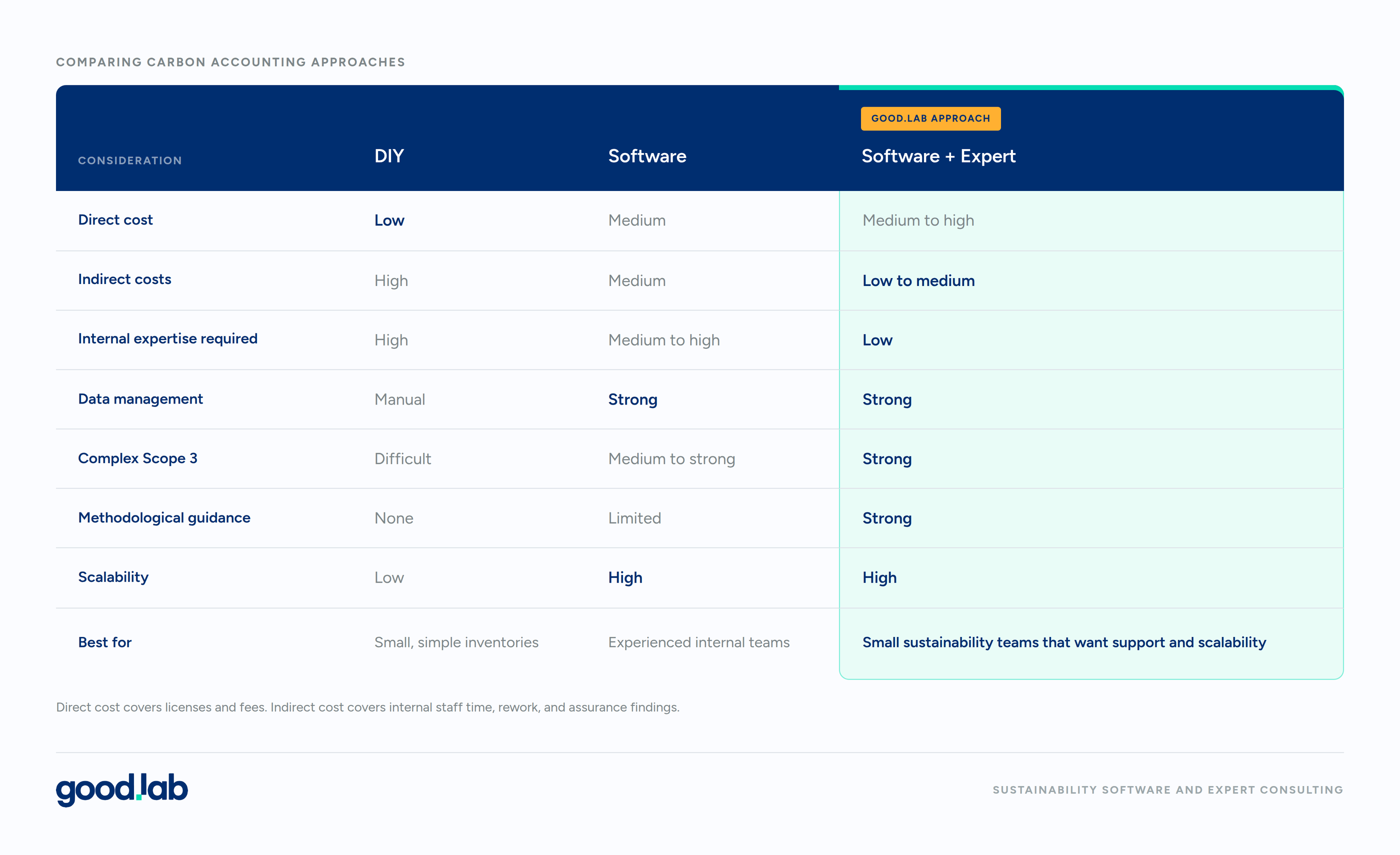
Carbon Accounting Software vs. DIY vs. Consultants with Software: How Do They Compare?
Each option involves trade-offs in cost, required expertise, and internal resources.
DIY Carbon Accounting: When Are Spreadsheets Enough?
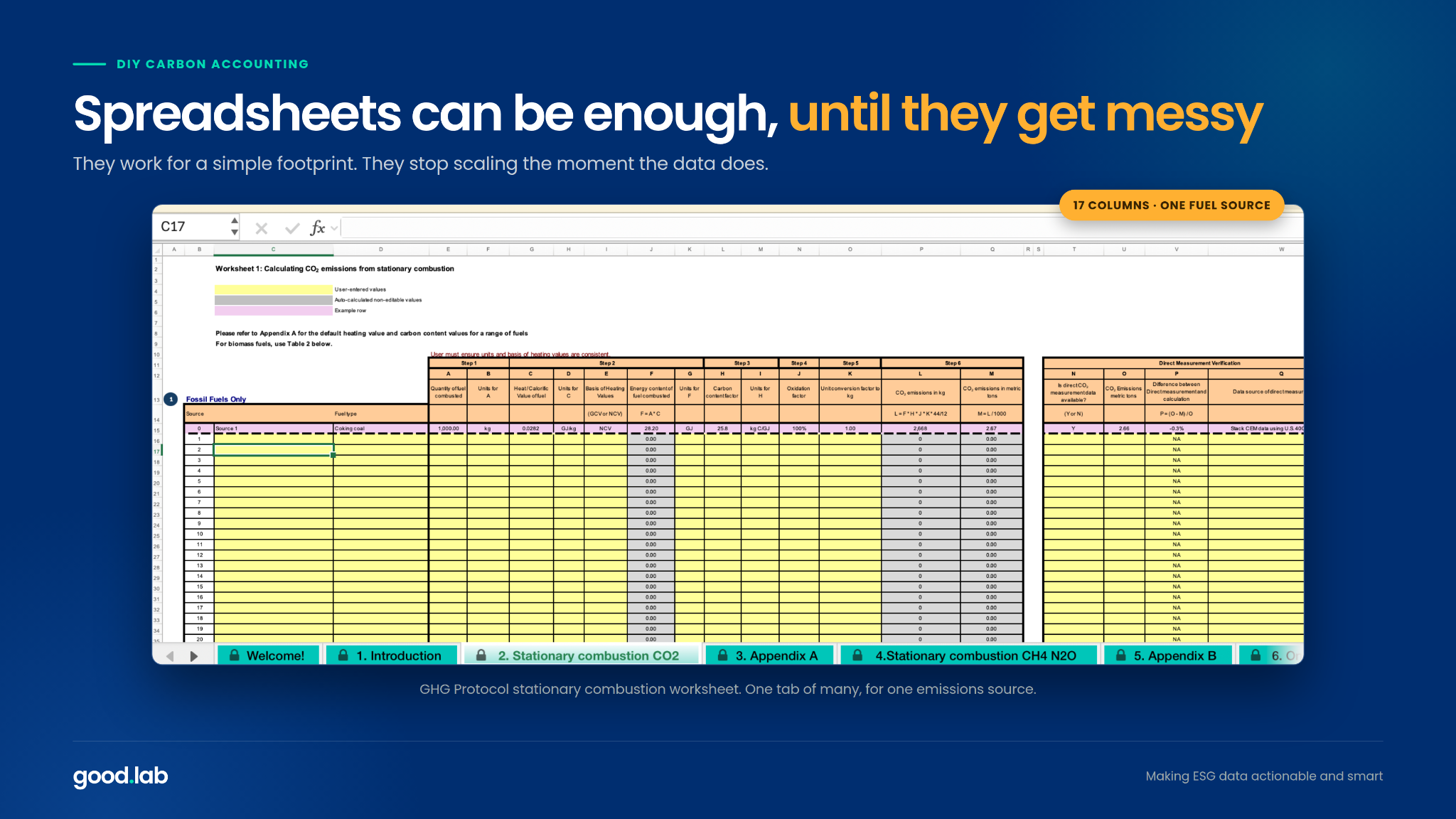
DIY only works within a narrow set of conditions, and it's worth being honest about them before you commit real time to the process.
Here are the narrow conditions where it could be considered:
- You have only a few facilities, and one entity.
- Your Scope 1 and 2 calculations are extremely straightforward.
- You don’t plan to measure Scope 3.
- You have limited data sources.
- Someone already internally understands GHG accounting very well.
But even then, it’s important to remember the baseline you set now doesn't stay contained to this year. It becomes the reference point every future inventory gets measured against, the number your reduction targets are built on, and the record a customer or regulator may eventually ask you to defend. If it's built on manual, error-prone data, that's what your company is standing on years from now, long after the spreadsheet itself has been replaced.
The primary carbon accounting methodology, the GHG Protocol, provides calculation guidance and tools for companies that still want to do it themselves, and the US EPA offers a Simplified GHG Emissions Calculator to help organizations build inventories.
The Hidden Cost of DIY Carbon Accounting
While the tools are available for free, the real cost is the time it takes an employee to collect, calculate, and maintain data.
Spreadsheets are also much harder to maintain than software and can quickly get complex, leading to errors that are far more expensive once they reach a regulator, a customer, or the public.
5 Signs You've Outgrown Spreadsheets
Spreadsheets may be ideal for smaller, simpler businesses, but they can quickly become cumbersome. Here are five signs it's time to change your approach:
- You’re spending much more time managing spreadsheets than you used to. Data collection and manipulation are consuming sustainability resources that could be used for decision-making and emissions reduction.
- You are bringing in more stakeholders to share data. More contributors mean more coordination, consistency, and version-control requirements.
- You are considering Scope 3 data collection. Supplier, procurement, travel, logistics, and other value-chain data can dramatically increase inventory complexity.
- You take repeated actions every year with similar data and emissions factors. Recurring manual work is a strong candidate for automation.
- You are encountering new questions and challenges that you can't answer confidently in-house. At this point, the problem isn't Excel skills. It's access to carbon accounting expertise.
At that point, the choice is a software provider, an expert, or better yet: both.
Carbon Accounting AI & Software: Who Is It Best For?
Purpose-built carbon accounting software platforms exist to make the workflow reliable, repeatable and scalable.
What Software & AI Does Well
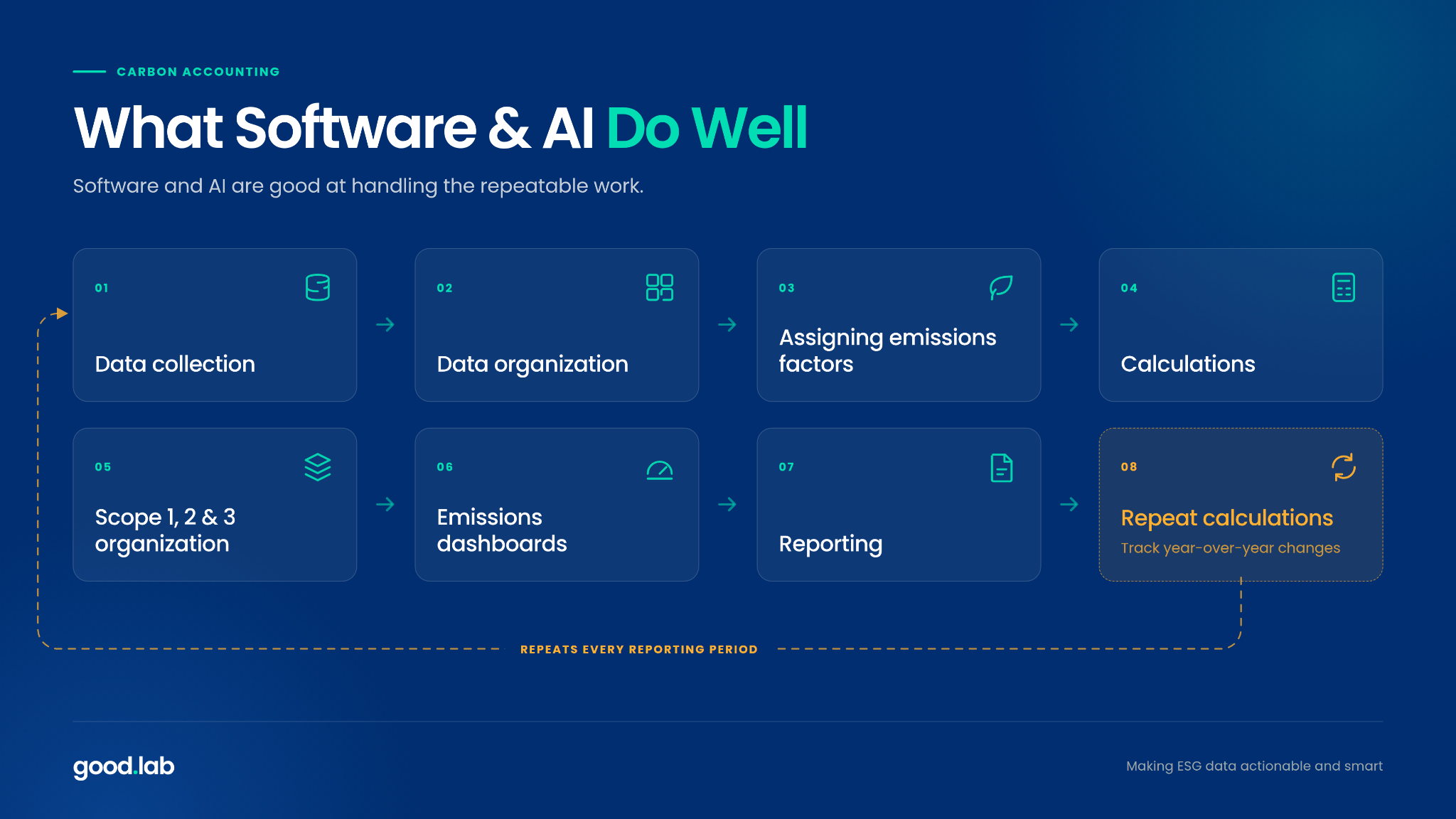
Software handles the repeatable work well. If you know how to use it, it can help you automate the carbon accounting process: from collecting data in a central repository, to automatically applying emissions factors, and generating simple reports.
It can also enable easy year-on-year tracking to assess decarbonization and performance against goals, like a science-based net zero target. It will also become increasingly valuable as data volumes, contributors, and reporting frequency increase.
What Carbon Accounting AI & Software Can't Do Alone
Although software can automate calculations, it doesn't eliminate the many nuances of carbon inventories or the need for judgment that comes from expertise.
Companies still need to answer complex questions like:
- What is the organizational boundary I should set?
- What data should I be collecting and in what form?
- Who do I get the data from?
- What do I do if there is no data or it’s too hard to get?
- Which Scope 3 categories are material?
- What calculation method should I use for each category?
Software can support some of these processes, but companies still need someone with deep experience and know-how to make defensible decisions about what to measure, when, and what to actually do with the information they collect.
Without a human element, software can also make mistakes, and AI-driven ones can hallucinate.
Which Carbon Accounting Approach Is Right for You? Get an Answer in 60 Seconds
The right approach depends on the level of assurance you need, the complexity of your inventory, the expertise available internally, and how much staff time you can spend.
Software + Expert Support: Combining The Best of Both Worlds
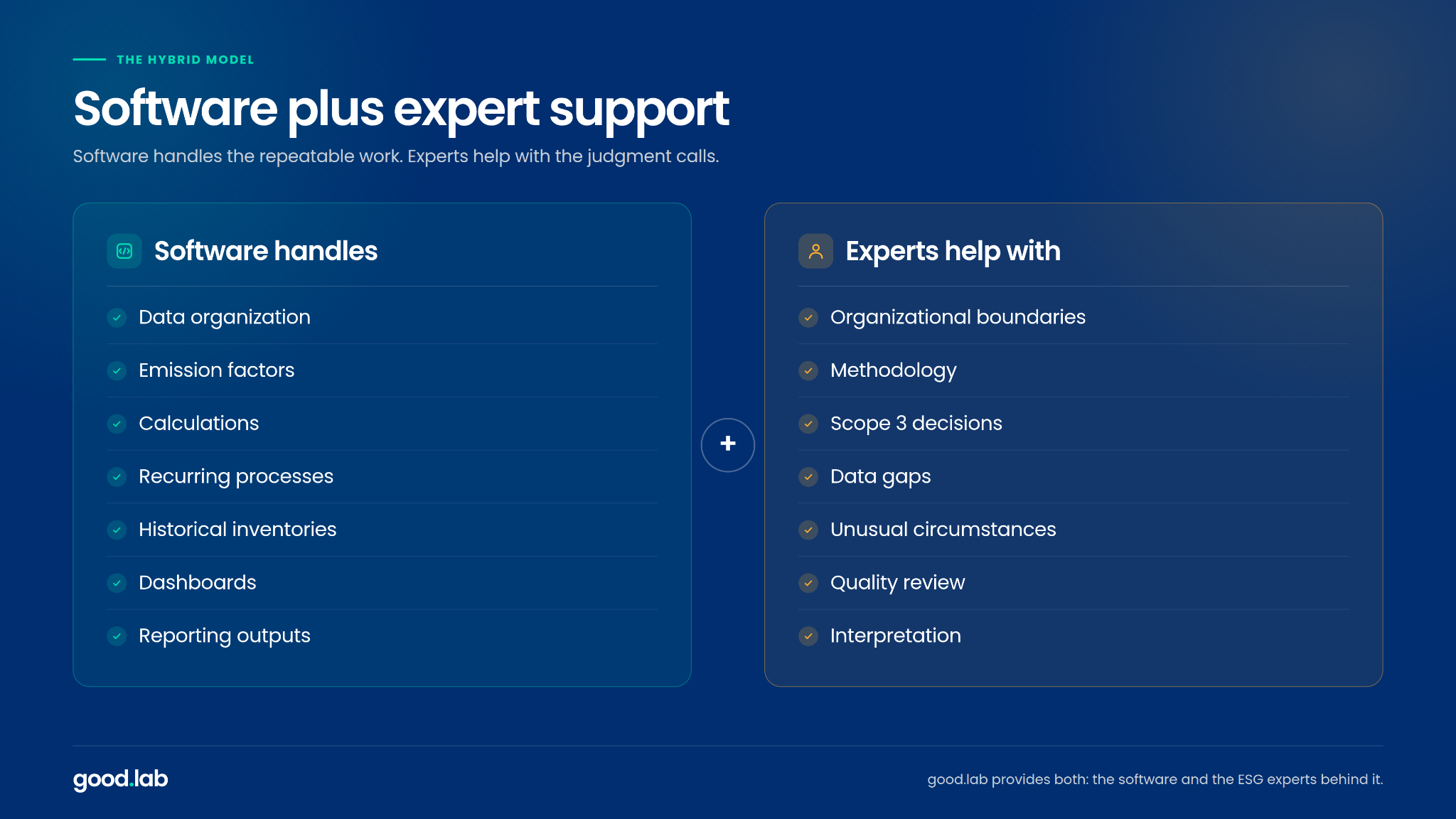
This hybrid model splits carbon accounting work according to what technology and people do best. Software handles what is repeatable, and a person handles all the judgment calls.
On the software side, that means a system organizes your data, applies emissions factors, and keeps your calculations current and audit-ready instead of scattered across spreadsheet versions.
On the expert side, it means you have a specific person you can ask when a Scope 3 category doesn't cleanly fit a category, when a data gap needs a defensible assumption, or when a customer questionnaire asks for something your inventory wasn't originally built to answer. In our experience, it solves many of the problems we consistently see in carbon accounting engagements.
That combination changes what happens when the questions your business runs into get more difficult year over year.
With software alone, a hard question sits unanswered until someone figures it out.
With software and expert support together, the answer gets built into your system, so the next person who asks the same question already has it.
Key benefits of the hybrid model include:
- A data trail: While static spreadsheet files with little context, software maintains a live, repeatable calculation trail you can update yourself.
- Reduced risk: Automated software checks catch data errors, but expert oversight catches judgment errors in complex areas like Scope 3.
- In-house upskilling: Teams get 1:1 guidance from climate specialists and build internal capabilities, instead of learning on their own on a platform.
- Cost efficiency: Modular expert support scales to what you need, rather than a full-scope consulting retainer.
- Long-term help: Whether you need help with sustainability reports, an Ecovadis assessment, a CEP assessment, or compliance with new regulations, the same consultant who already knows your organization will be there for any future issues.
Together, software and experts produce a scalable, compliant, and defensible inventory, and companies keep ownership of their emissions data and processes.
The same dataset can then do more than one job it would do with software alone: stakeholder reporting, energy analysis, decarbonization planning, and supplier engagement.
Finding the Right Balance Between Technology and Expertise
Spreadsheets can work when carbon accounting is extremely simple, but it’s worth remembering: even a simple footprint sets a baseline, and that baseline is what every future inventory gets measured against, whether the spreadsheet that built it is still in use or not.
Software becomes valuable as the work needs to scale, but scale isn't the same as judgment. A platform can keep pace with more facilities, more contributors, and more reporting cycles. It still can't decide what belongs in your emissions boundary or which Scope 3 categories matter.
That’s why expertise stays critical no matter which path you’re on. Miscalculation is rarely the biggest risk during an emissions audit. An undocumented judgment call that nobody can defend later is.
Software and expert support together mean you get both: the data stays in your system, and the judgment calls get made by someone who's made them before.
That's the model Good.Lab is built around. Instead of asking you to choose between a platform and a person, we pair carbon accounting software with dedicated sustainability experts who work closely with your team, so you get scalable data collection and someone to call.
Curious what that looks like for your company and GHG inventory? Book an intro 20min call with Good.Lab, and we’ll walk you through it.