

For years, sustainability pressure on apparel companies came from customers, retailers, and investors. In California and other jurisdictions, it now comes from regulations. SB 707, the Responsible Textile Recovery Act of 2024, makes brands and other producers financially responsible for what happens to clothing and textiles after consumers throw them away. It is the first extended producer responsibility (EPR) law for textiles in the United States taking effect in 2026.
The scale explains why California acted. The state disposes of roughly 1.2 million tons of textiles a year. Now producers will be responsible for that. SB 707 makes them pay for the disposal based on how much clothing they sell and what it is made out of. This article will explain what SB 707 means for apparel companies, how they can prepare, and how to reduce costs.
What SB 707 requires
SB 707 requires producers of covered apparel and textile products sold into California to join a single producer responsibility organization (PRO). That organization designs and runs a statewide system for collection, repair, reuse, sorting, and recycling. Producers fund it through fees, report annually, and must meet performance standards set in the PRO's plan.
CalRecycle approved Landbell USA as the sole PRO on February 27, 2026. Every covered producer had to join by July 1, 2026. Registration for the 2026–27 period carries a flat $1,000 fee to fund the statewide needs assessment. Full fees are expected to come after 2030, once the stewardship plan is approved.
If you sell covered products into California and haven't registered, you are already behind the statutory deadline and could be liable for penalties.
Who counts as a producer under SB 707?
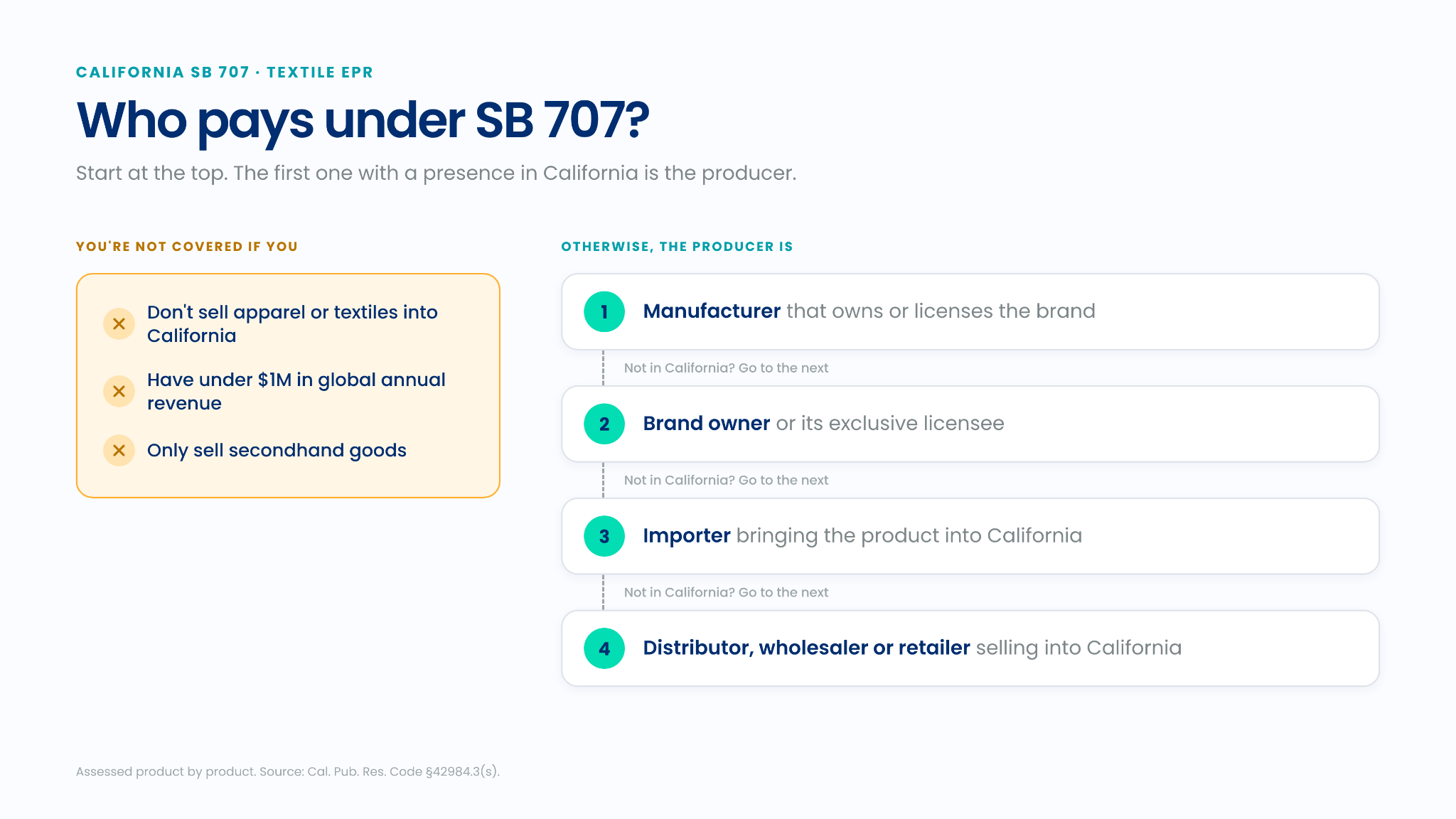
SB 707 assigns responsibility through a tiered definition, so that someone in the chain always carries the obligation. It starts with the manufacturer that owns or licenses the brand. If that party has no California presence, the obligation moves to the licensee, then the importer, then the distributor or retailer. In practice, retailers can end up obligated for private-label goods and for brands with no presence in the state.
Two exemptions apply:
- Sellers of only secondhand goods
- Businesses with under $1 million in annual global revenue. That threshold is global, not just California sales.
Selling online doesn't get you out. Brands that ship into California from anywhere are covered. Online marketplaces will also have to report third-party sellers with more than $1 million in covered product sales.
CalRecycle will publish a list of compliant producers, and retailers will be barred from selling covered products from producers who aren't on it. That makes non-compliance a market access problem, in addition to any fine.
What products are covered
Apparel is the most impacted sector, but the covered products go well beyond apparel companies. It includes:
- Clothing
- Undergarments
- Footwear
- Swimwear
- Uniforms
- Accessories such as handbags, backpacks and scarves
- Home textiles such as bedding, towels, tablecloths, linens, curtains and fabric window coverings
This could bring in home goods, bedding, and other businesses that may still be covered under the law as textile producers.
The SB 707 timeline
When penalties do eventually apply, they will reach up to $10,000 per day, or $50,000 per day for intentional or knowing violations. They attach when the stewardship plan is approved or on July 1, 2030, whichever comes first.
SB 707 litigation has not stopped the rule
In March 2026, the American Apparel & Footwear Association (AAFA) sued CalRecycle over its choice of Landbell. AAFA argues that Landbell was not formed by producers and does not meet the law's nonprofit and governance requirements.
That doesn't mean the program stopped. On September 17, the court denied AAFA's request for a preliminary injunction. Implementation and Landbell's work continue while the case proceeds, and the hearing on the underlying challenge is set for March 2027. Whoever ends up running the program, the producer obligations in the statute stay the same.
The real work is the data
Registration to Lanbell in 2026 is the easiest part of compliance. Fees, data collection, and eco-modulation to reduce fees will be harder.
Producers will report the quantity and weight of covered products sold into California, broken down by fiber type and Harmonized Tariff Schedule (HTS) code.
Fees will be eco-modulated: more durable, repairable, or recyclable products pay less, and harder-to-recover products pay more.
The inputs that will determine the rates already sit in your systems, usually scattered across product development, sourcing, enterprise resource planning (ERP), and e-commerce platforms. That means building a SKU-level dataset that most apparel companies don't have today, containing information around:
- Material composition by fiber
- Unit weight
- HTS code
- California-attributed sales
Companies that start now can model fee exposure before rates are set, join CalRecycle workshops with real numbers, and spot design changes that lock in lower fees.
The good news is some of this data can be used more than once, feeding more accurate product-level carbon footprints, Scope 3 emissions, and adding substance to customer questionnaires such as EcoVadis.
👉 If you haven't measured your carbon footprint yet, here’s why every apparel company should measure its GHG emissions.
California stands alone, for now
When SB 707 passed, Washington and New York introduced similar bills within months. Neither has passed yet, and they are currently stalled in the legislature.
Washington's bill (HB 1420) was rewritten in 2026 as a study-only needs assessment and never reached a floor vote. New York's bill (S3217A) stayed in committee when the session closed in June. Both states are expected to return to textile EPR in 2027, with California as their reference point.
Meanwhile, the EU's ban on destroying unsold apparel and footwear took effect for large companies on July 19, 2026, and it applies to US brands selling into Europe.
For multi-state and multinational brands, the lesson from packaging EPR holds. One state becomes seven faster than expected, and each has its nuances.
How Good.Lab helps apparel companies prepare
SB 707 is another requirement landing on teams already handling packaging EPR, customer questionnaires, and, for larger brands, California's climate disclosure laws. Good.Lab's EPR compliance approach was built for that kind of stacking:
- Map your obligations. We confirm whether you are the obligated producer, which products are covered, and what you owe, with a documented rationale behind every call.
- Centralize your product data. We build one SKU-level dataset covering fiber, weight, HTS code, and state-level sales. We flag any gaps early and tell you exactly what's needed to close them.
- Model your exposure. We estimate fee exposure as rates are published and identify design and sourcing changes that lower it.
- Reuse the work. The same dataset feeds your GHG inventory, product footprints, and customer reporting, so your team isn't rebuilding it every time.
We've supported apparel companies including Bioworld and TKO on climate data and supply chain compliance.
SB 707's fees are still being written. The data that will decide what you pay is already in your systems. Talk to an expert about where your exposure sits and what to build first.